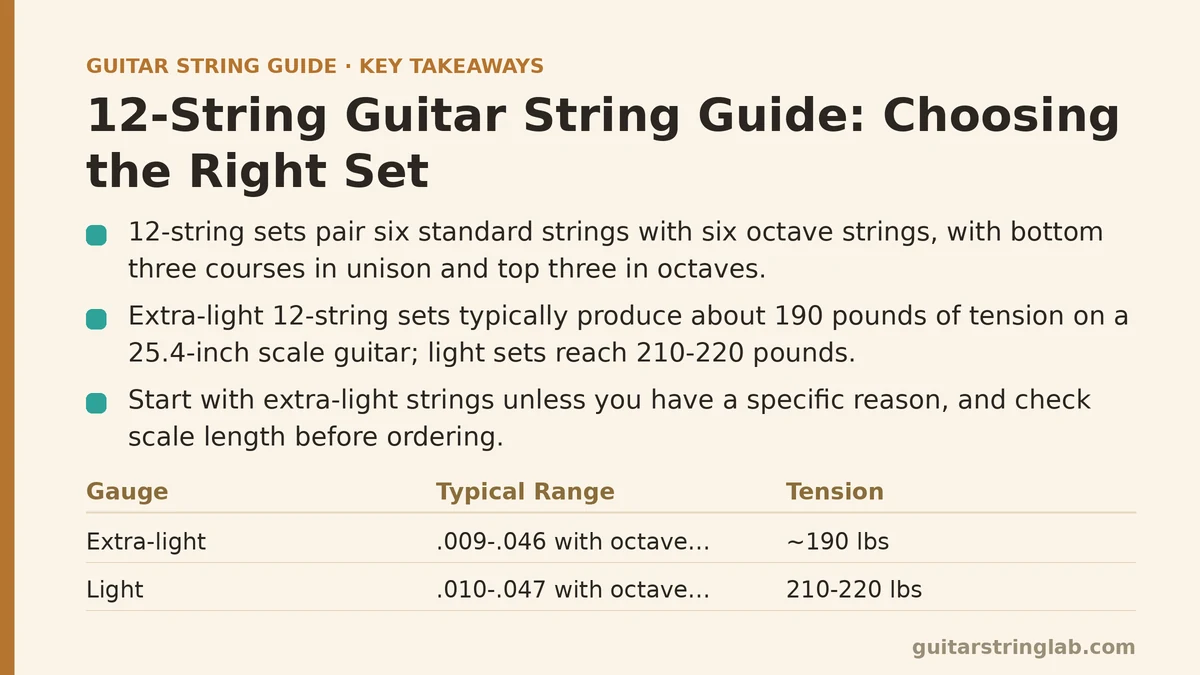
A 12-string set is six standard strings plus six octave strings, paired into six courses. The bottom three courses — low E, A, and D — run in unison, both strings sounding the same pitch. The top three courses — G, B, and high E — pair a standard string with a thinner octave string tuned one full octave higher. That structure is the reason twelves break strings more often, carry higher overall tension, and reward careful gauge selection more than any six-string does.
It also explains the cost. A 12-string set runs roughly double a standard six-string set, and it tends to last about half as long. The extra strings change the economics, the playability, and the tuning stability of the instrument in ways a six-string player won’t anticipate.
Myth: Any 12-String Set Works on Any 12-String Guitar
The most common mistake in shops is a player grabbing a bright red package labeled “12-String” without checking the gauge, assuming it’s all the same. It isn’t. The two dominant gauges differ meaningfully, and your guitar’s scale length — the distance from nut to bridge — determines which one you can realistically use.
The available options: Most bronze 12-string sets come in either extra-light (typically .009-.046 with octave strings from .004-.024) or light (typically .010-.047 with octave strings from .004-.026). The extra-light set produces roughly 190 pounds of total string tension on a standard 25.4-inch scale dreadnought. The light set pushes closer to 210-220 pounds. That difference may not sound huge, but it translates to noticeably higher action over time, extra stress on the bridge plate, and a stiffer feel under your fingers.
Why scale length changes everything: If your guitar is a smaller-bodied model (parlor, some grand concert sizes, or a 24.9-inch scale), even an extra-light set can feel tight. If it’s a jumbo or dreadnought with a longer scale, you might find light strings too stiff and prone to pulling the top forward over years of use. Measure your scale length or check your manufacturer’s spec sheet before ordering. Then start with extra-light unless you have a specific reason not to.
The mistake and fix: A light set goes onto a lightly braced concert-sized 12-string, and within two weeks the action is climbing and the bridge is starting to lift slightly. That’s not the guitar failing — it’s the set being wrong for the instrument. Drop to extra-light and have a luthier check the brace and bridge for any lasting distortion.
Myth: An Octave String Is Just a Thin Version of the Regular String
Many players treat the octave strings as afterthoughts, assuming they’re simply lighter-gauge versions of the main strings that can be substituted freely from any six-string set. In practice, manufacturers use specific alloys, core-to-wrap ratios, and tension curves for those thin strings. Substituting random singles from a six-string bulk box almost always results in intonation problems near the fifth fret and strings that feel floppy for a week before snapping.
The technical reality: Octave strings in a 12-string set are engineered with different tension per string than a six-string set’s high E. For example, the octave G string in a typical light set is about .024 inches, but its tension is balanced against the .010 plain G it pairs with. Replace it with a standard .024 wound string from a bulk pack, and the tension curve shifts — the string may not seat correctly in the nut slot. Even small gauge changes across a twelve-string cause audible detuning across the paired courses.
The practical rule: Replace 12-string strings only with strings from the same set family. If an octave string breaks, buy a replacement single from the same manufacturer and set name, or just buy a fresh full set and swap all six octave strings. Mixing brands across courses leads to inconsistent brightness and tuning drift you’ll chase for weeks.
Myth: You Need to Tune a 12-String to Full Standard Pitch Always
This myth persists because the instrument’s sound is defined by that lush, chorused standard tuning. The other side of the argument shows up in every repair shop’s schedule: tuned to standard pitch, a 12-string puts enormous, continuous static load on the neck and top, leading to bowed necks, bellying tops, and cracking bridge plates on instruments that weren’t built for that tension.
The alternative worth knowing: Tuning down a whole step to D standard (D-G-C-F-A-D for the main courses, with octave pairs as described) reduces total tension by roughly 20-25%. For many 12-strings — particularly vintage instruments, lightly braced models, or guitars with bolt-on necks — this is the intended playing pitch. You get the same interval relationships, same chord shapes, same chorus effect, and nearly the same tone, with a fraction of the structural stress. A capo at the second fret returns you to standard pitch positions while keeping the relaxed tension.
The failed experiment many players try: Installing an extra-light set and tuning to standard pitch on a guitar that was already on the edge of structural tolerance. The strings themselves won’t break immediately, but within months the neck bows and the action becomes unplayable. The better path: check your guitar’s label or manual for its recommended tuning, and when in doubt, start at D standard with extra-light strings.
Myth: Coated Strings Solve All 12-String Maintenance Problems
Coating extends the life of a string set, and on a 12-string — where the cost per full set is double — that extended lifespan matters. But coating doesn’t address the most common failure mode of 12-string sets, which is octave string breakage at the bridge and nut.
Why octave strings break faster: The thinner octave strings (often .004 to .010 plain steel) have smaller cross-sectional area and greater vulnerability to burrs in nut slots and bridge pins. A tiny rough spot on a saddle or a pin hole that’s not perfectly smooth fatigues a thin string far faster than a string twice its diameter. Coating doesn’t add structural strength at the fail point; it adds corrosion resistance on the surface.
The better investment: Rather than paying extra for a coated set and still snapping octave strings, spend that money (or ask your tech to spend it) on polishing the nut slots, bridge pin holes, and saddle contact points. Smoothing these surfaces with fine abrasives (1000-grit or finer) measurably reduces string breakage across all courses. If you still want coated strings, they’ll help control corrosion and gunk buildup on the wound strings, but don’t expect them to fix a bridge burr that’s chewing through your .004 octave strings.
Myth: Thicker Strings Always Give a Bigger, Fuller 12-String Sound
It’s tempting to assume the opposite: more metal equals more output and more bottom end. On a six-string, that logic holds up reasonably often. On a twelve-string, it collapses against physical reality.
The counterintuitive result: Because of how paired courses interact, the fullness of the 12-string chorus effect depends more on the relationship between the main string and its octave partner than on absolute gauge. When both strings in a course are too heavy, the fundamental dominates and the octave shimmer shrinks relative to it. On several dreadnoughts and jumbos, switching from light to extra-light sets has consistently produced a clearer, more spacious chorus effect — the octave string more audible in the blend rather than buried under the heavier fundamental. Players often describe it as “more 12-string sound” even though total string gauge was lower.
The flip side of that tradeoff: Extra-light strings give up dynamic headroom and projection. Play fingerstyle in a quiet room and you’ll hear the benefit immediately. Strum hard in a band context with other instruments and the lighter set may get buried. The fix isn’t necessarily thicker strings — it’s strategic tension balance. Some players prefer a hybrid setup where the wound lower courses are slightly heavier and the top courses (where octaves live) stay lighter. That’s a legitimate option if your nut slots accommodate mixed gauges and you set your intonation afterward.
Choosing the Right Set: A Decision Tree
Keep this logic in mind when you’re at the store or ordering online:
| Condition | Recommendation |
|---|---|
| Guitar is vintage, lightly braced, or has a bolt-on neck | Start with extra-light, tuned to D standard |
| Guitar is a modern dreadnought or jumbo with a solid top | Start with extra-light at standard pitch, or light set at D standard |
| Your action has crept up over time and neck relief is high | Drop to extra-light and check truss rod and bridge before buying a heavier set |
| You play fingerstyle in quiet settings | Extra-light, uncoated, for maximum tone and chorus clarity |
| You gig with heavy strumming and need projection | Light set at D standard with a capo, or extra-light at standard pitch with a quality pickup |
| Breakage is your biggest problem | Check for burrs first, then buy a set with a slightly heavier octave gauge (some manufacturers offer “reinforced” octave strings) |
What to Do Next, Starting Today
First, find out your guitar’s scale length and any recommended tuning from the manufacturer. That takes under two minutes with a tape measure and your manual or an online search.
Second, choose a set with that information, not just whatever’s on the shelf. For most players, that means an extra-light bronze set from a reputable maker (Elixir, D’Addario, Martin, or Ernie Ball all make consistent 12-string sets). Buy a single full set — don’t try to assemble one from loose singles.
Third, install the set, tune to D standard first, and play for a full week before deciding anything. Test whether the octave strings are audible when you strum lightly near the soundhole. If they are, you’ve got the right blend. If they’re buried, consider a lighter gauge in the top courses. If the action is too high after the strings settle, take it to a luthier for a setup rather than swapping strings yet again.
The players who get decades of trouble-free 12-string playing aren’t the ones who found a magic string brand. They’re the ones who matched the set to the instrument, tuned for structure, and smoothed out the contact points that kill thin strings.
What 12-string guitar model are you stringing, and what gauge is on it now? Provide your guitar’s scale length and whether you’re tuning to standard or down, and a specific set can be recommended to try next.
Related guides: Guitar String Gauge Guide, How String Gauge Relates to Guitar Scale Length, and Guitar String Materials Explained.