By the end of this post, you’ll know how to measure your storage environment, pick the right humidifier or dehumidifier for your climate, and set up a weekly routine that prevents the repair bills most guitar owners eventually face. The starting point is understanding what a case can and can’t do.
A guitar case does not provide complete protection from the environment, even though plenty of players assume it does. A closed case doesn’t create a controlled climate — it just slows the exchange of air between inside and outside. Wood keeps breathing, moisture keeps moving, and temperature swings keep stressing the instrument. The case shields against bumps and dust, not humidity.
Grasping that distinction early keeps you away from the most common repair bills in the guitar world: cracked tops, lifted bridges, fret sprout, and necks that lose their relief. Every one of those failures traces back to uncontrolled moisture levels, and every one is preventable with a storage system that costs less than a single setup appointment.
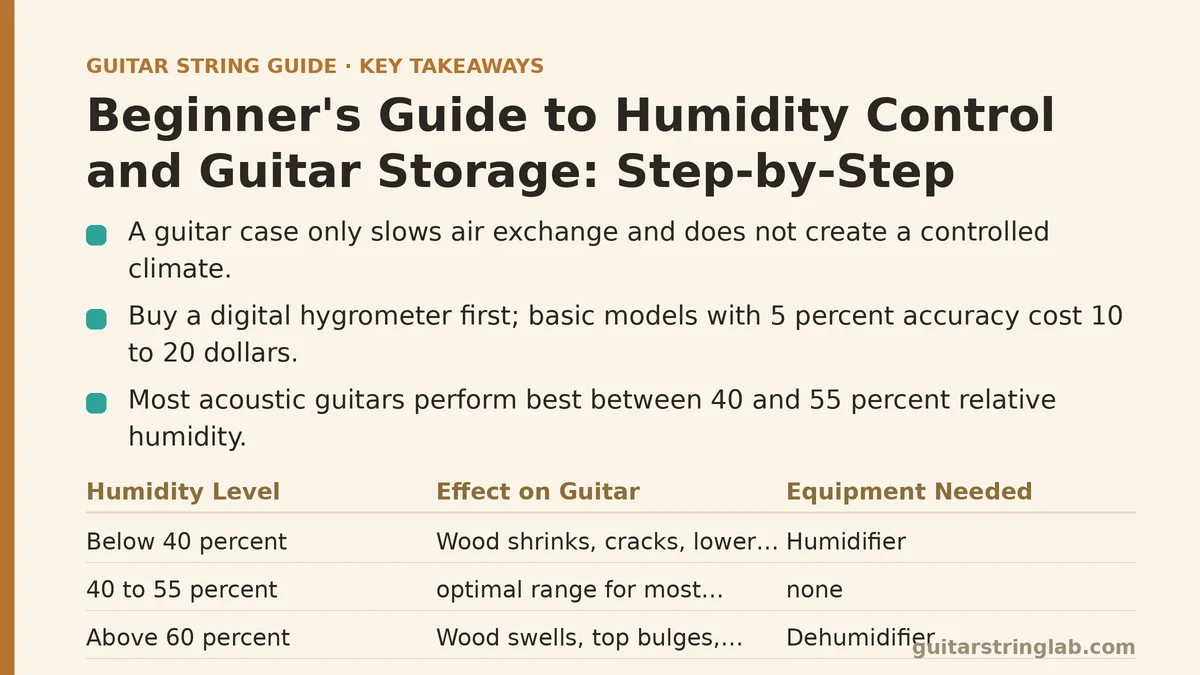
| Factor | Dry Conditions (Below 40% RH) | Humid Conditions (Above 55% RH) | Ideal Range (40–55% RH) |
|---|---|---|---|
| Main Risk | Cracking, shrinking, fret sprout | Swelling, top bulge, lifted bridge | Stable wood, consistent action |
| Solution | Humidifier | Dehumidifier | No active control needed |
| Equipment Options | Room unit or case humidifier | Dehumidifier | — |
| Typical Cost | $40–$80 room; $10–$25 case | Not stated in excerpt | — |
| Maintenance | Daily fill (room); re-wet every 3–7 days (case) | Not stated in excerpt | — |
| Common Climate | Dry regions; winter heating | Humid regions; Southern summers | — |
| Measurement Tool | Digital hygrometer ($10–$20, ±5% RH) | Digital hygrometer ($10–$20, ±5% RH) | Digital hygrometer ($10–$20, ±5% RH) |
| When to Act | Low reading below 40% | High reading above 55% | Readings hold for a full week |
Step 1: Measure Your Environment Before Buying Anything
Buy a digital hygrometer before you spend a dollar on humidifiers or dehumidifiers. Data comes first. A basic digital hygrometer with ±5% relative humidity accuracy runs $10–$20 and displays both temperature and humidity. Put it in the room where you store your guitar — not in the case — and leave it for 24 hours. Take readings in the morning, at midday, and in the evening so you can see the daily swing.
Most acoustic guitars, and many electrics with set necks, perform best between 40% and 55% relative humidity. Drop below 40% and wood starts losing moisture and shrinking, which opens cracks and lowers the action. Climb above 60% and wood absorbs moisture and swells, raising the action and making the top bulge or the bridge lift.
If your readings hold between 40–55% for a full week without intervention, active humidity control may not be necessary. If they drift outside that band for more than a few days at a stretch, move on to the next step.
Step 2: Identify Your Seasonal Pattern
Let the hygrometer run for at least a week before deciding which equipment to buy. Every climate has a pattern, and your equipment should match your specific problem.
Dry climates, and winter heating season in general, commonly push indoor humidity down to 25–35%. That’s the cracking zone. Humid climates, or summer months across the South and Midwest, can leave indoor humidity sitting at 65–75% — the swelling zone. Some regions swing between both extremes over the course of a year, which means you need equipment for both directions.
If your low reading falls below 40%, a humidifier is the answer. If your high reading exceeds 55%, you need a dehumidifier. If you get both, plan on seasonal equipment swaps.
Step 3: Humidify With a Room Unit or a Case Solution
For guitars stored in a room rather than a case, a room humidifier rated for 300–500 square feet is the most reliable option. Ultrasonic and evaporative units both work; evaporative models self-regulate to some degree because they release moisture based on how dry the air currently is. A quality room unit runs $40–$80, plus annual filter or wick replacements in the $10–$25 range. Fill it daily during dry months — most units hold 1–2 gallons and run 12–24 hours per fill.
If your guitar lives in its case most of the time, a case humidifier is lighter and cheaper. Damp-sponge systems that fit in the soundhole or inside the case cost $10–$25 and last several months before the sponge or slow-release gel needs replacing. You’ll need to re-wet them every 3–7 days depending on ambient dryness. The tradeoff is manual maintenance, but you get precise delivery exactly where the guitar lives.
Whichever humidifier you pick, place the hygrometer inside the case for case-based systems, or near the guitar for room-based systems, and confirm the reading stays in range for a week.
Step 4: Dehumidify When Your Readings Trend High
High humidity is less dramatic than cracking but just as damaging over time. A swollen guitar top raises the action, creates buzzing, and can pull the bridge loose. On electrics, a warped neck throws off intonation and string height in ways that mimic mechanical problems.
For a room, a dehumidifier rated for a small to medium space (400–800 square feet, 30–50 pint capacity) costs $100–$200 and needs its collection bucket emptied every day or two depending on output. Many models drain continuously through a garden hose to a floor drain, which removes the emptying chore entirely.
For cases, silica gel packets in 50-gram or 100-gram sizes absorb ambient moisture until saturated. Drying them in a low oven (150°F for 30 minutes) restores their capacity so you can reuse them. A case with two 100-gram packets handles mild humidity; for serious conditions, step up to a small rechargeable dehumidifier unit designed specifically for guitar cases, which runs $30–$50 and cycles automatically.
Step 5: Control Temperature to Avoid Sudden Swings
Humidity control falls apart if temperature swings are large, because relative humidity changes with temperature even when absolute moisture stays constant. A room at 70°F and 45% humidity behaves differently at 60°F — the same air now reads 55–60% relative humidity, which moves you out of comfortable and into risk territory.
Keep your storage space between 65°F and 75°F year-round. Stay away from exterior walls, rooms that get direct afternoon sun, and spaces near radiators, vents, or fireplaces. A guitar closet under a staircase often works well because it stays thermally stable.
Sudden moves between hot and cold environments matter too. Going from a 75°F room to a 30°F car and back stresses wood and finish. Give the guitar a 30-minute temperature acclimation period in the case before opening it in a new environment.
Step 6: Use a Stand or Case Strategy That Matches Your Usage
Guitars played daily benefit from living on a stand in the controlled room. The convenience of pickup-and-play outweighs the small humidity exposure — provided the room sits within the 40–55% range. Guitars played less than weekly should go back into a sealed case, which dampens minor swings and protects against accidents.
If you use a stand, avoid floor stands near exterior doors or HVAC vents. A wall-mounted hanger is the better choice if your floor space sits in a drafty pathway. Both options cost $15–$50. The room humidity data from Step 1 tells you whether a stand is safe at all.
Step 7: Set Up a Weekly Inspection Routine
A five-minute check each week catches early problems before they turn expensive. Look at the top for cracks or finish lines, especially ones running from the bridge toward the soundhole on acoustics. Check neck relief by sighting down the fingerboard — a concave bow or a back-bow points to moisture imbalance. Slide a finger along the fret ends; any sharpness means fret sprout from dryness. Then confirm the hygrometer reading has stayed in range since your last check.
If you spot cracks or bridge lifting, remove the strings, place the guitar in a controlled environment (ideally 50% humidity at 72°F), and wait 2–3 days before reassessing. Many minor cracks close up when moisture returns, and repair cost drops sharply when you address them early.
For fret sprout, the fix is often simple: wait for humidity to rise above 45%, and the fret ends typically retract into the fingerboard as the wood expands. If they’re still sharp after a week at proper levels, a luthier can file them down for $50–$100.
Common Mistakes and Quick Recoveries
Over-humidifying: A room humidifier left running on high in a small space can push humidity past 65% within a day. Recovery: take the guitar out of the room, open the case, and ventilate for a few hours. Then recalibrate your humidifier’s output setting and monitor for 48 hours.
Using the wrong humidifier type: Hot steam humidifiers control relative humidity poorly because they add variable moisture depending on boiler cycles. Stick to ultrasonic or evaporative units for consistent output.
Ignoring the case’s own microclimate: A case stored in a garage at 50°F with 70% humidity is worse than a guitar on a stand in a controlled living room. Keep the case in the same controlled room as the guitar, even when the guitar is inside it.
Drying silica gel on high heat: Temperatures above 180°F melt the gel’s pouch material and damage the crystals. Use 150°F or lower, and check every 10 minutes.
The Minimum Viable System
If you manage one room and one guitar, the minimum full setup costs roughly $60–$120: a hygrometer ($15), a humidifier or dehumidifier sized to the room ($40–$100), and a basic floor or wall hanger ($15–$30). That’s less than the cost of a single crack repair, which typically starts at $150 and climbs quickly.
The same system scales for multiple guitars — add one hygrometer per room, and increase the humidifier or dehumidifier capacity by roughly 10–15% per additional instrument stored openly.
What to Do Today
Don’t buy equipment yet. Run the 24-hour hygrometer measurement first. Write down the morning, midday, and evening readings. If they stay between 40% and 55%, your current storage is probably fine — focus on temperature stability and the weekly inspection routine. If they drop below 40% or rise above 55% for a consistent stretch, you now know which direction to buy equipment, what capacity you need, and where the problem lives.
What did your 24-hour hygrometer reading show for your typical storage room? Share your low and high numbers, and you can sort out whether a humidifier, a dehumidifier, or simple repositioning solves your situation first.
Related guides: How Humidity Affects Guitar Strings and Tone, Guitar String Storage Tips, and How Long Do Guitar Strings Last.