You can tune every open string to dead center and still have a guitar that plays out of tune. The open low E can read perfect on the tuner while the 12th fret harmonic on that same string reads 15 cents sharp—and no amount of retuning the peg will close that gap. That split between open pitch and fretted pitch is what intonation actually is, and it’s a big reason players abandon a setup halfway through and hand the guitar to a tech.
Here’s the part most guides bury: intonation fails for a short list of predictable reasons, and plenty of them live nowhere near the bridge saddles you were told to adjust first. Chase the wrong variable and you’ll burn an hour turning screws that were fine all along. What follows is the set of myths that keep players looping, then a working order for finding the real cause.
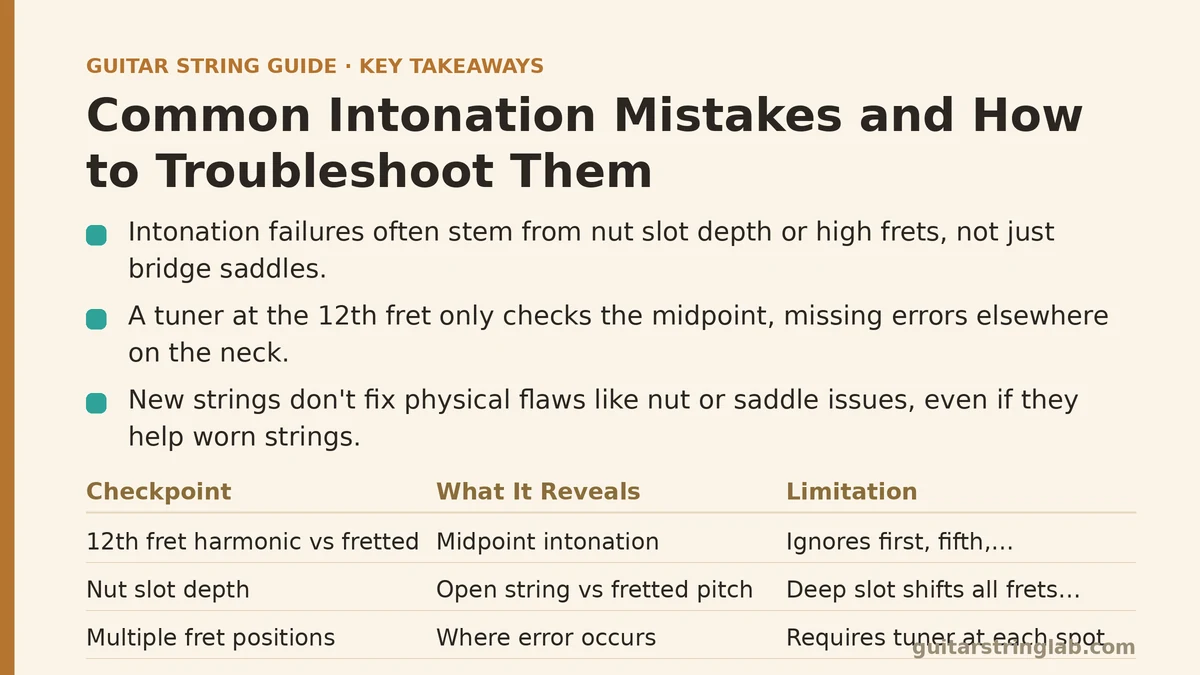
Myth: Intonation Is Always a Bridge Saddle Issue
Standard advice says grab a screwdriver and start walking the saddles forward or back. That’s the right move for roughly half the cases you’ll encounter. The other half are upstream problems that saddle travel cannot touch.
Reality: Before a fretted note even exists, the string runs from the nut to the tuning post, through the nut slot, over the fretboard, and across the saddle. Each of those contact points shapes the string’s effective vibrating length. Cut a nut slot too deep and the string sits lower over the first fret than it should, so everything from fret one upward reads sharp against the open string. Sliding the saddle back to compensate stretches the open length and throws the open tuning further off. A slot depth error of just 0.2 millimeters can shift intonation by 5 to 10 cents along the entire neck.
Myth: A Tuner at the 12th Fret Tells You Everything
Comparing the 12th fret harmonic to the fretted note is the go-to diagnostic, and it’s a solid one. It just doesn’t cover the whole instrument.
Reality: That 12th fret check only verifies the string’s midpoint. It tells you nothing about behavior at the first fret, the fifth, or the seventeenth. A single high fret partway down the neck pushes the string sharp at that one spot while the 12th fret still reads clean. You can dial a saddle until the octave is flawless and still own a guitar that plays out of tune through the middle of the neck. Set the tuner at several positions—first, fifth, ninth, twelfth, fifteenth—and chart where the error shows up before you touch hardware.
Myth: New Strings Always Fix Intonation
Fresh strings are good maintenance. They are not a repair for a physical flaw in the nut, saddle, or fret tops.
Reality: A worn string with uneven winding can introduce small intonation errors, particularly on wound strings, once the core wire starts separating from the wrap. But if a brand-new set reproduces the same 15-cent gap at the 12th fret, the string was never the culprit. Inspect the saddle and nut before dropping money on a premium set in hopes of a cure.
Myth: The Saddle Position on the Scale Length Is the Only Thing That Matters
A popular formula says measure the scale length, set the saddle that distance from the nut, and call it done. That ignores what tension does to a string.
Reality: Correct intonation puts the saddle slightly beyond the exact scale length, compensating for the extra tension created when you press a string to a fret. How much compensation you need shifts with string gauge, action height, and tuning. Heavier strings stretch further under the same finger pressure and demand more compensation; a taller action adds stretch too. The right saddle position isn’t a fixed number—it’s whatever distance lines the fretted notes up with the open tuning on your setup.
Myth: Nuts and Frets Are Not Part of Intonation Setup
Spend ten minutes on a guitar forum and you’ll see “scoot the saddle” repeated as though nothing else on the instrument exists.
Reality: The nut and the frets are the two most overlooked pieces of the intonation puzzle. A nut slot cut too narrow grips the string and keeps it from seating fully at the bottom of the slot, lifting string height over the first fret. That extra height stretches the string and sharpens the first couple of frets even when the 12th reads clean. Uneven frets—one sitting taller than its neighbor, or a loose fret riding slightly proud—deflect the string differently at that spot, creating a localized sharp or flat that no saddle adjustment can erase.
The Real Troubleshooting Order
Resist the bridge until everything else is ruled out. Work in this sequence and most intonation problems reveal themselves inside twenty minutes.
Step 1: Confirm the string is properly seated at the nut. Fret the third fret, then look at the string above the first fret. You want a sliver of clearance—roughly the thickness of a piece of paper. If the string rests on the first fret while you hold the third, the slot is too shallow. If the gap is clearly wider, the slot is too deep or the nut sits too high. Either condition produces inconsistent pitch down at the low frets.
Step 2: Check the saddle contact point. Drag a finger along the saddle and feel for burrs or sharp edges. A clean string should glide freely across it. A burr snags the string and alters its effective length as it vibrates, giving you a slightly sharp reading that pops up at random positions. On a six-saddle bridge, every saddle has its own intonation screw—verify the saddle isn’t tilted or lifted on one side.
Step 3: Measure relative humidity. Sounds off-topic, but wood moves. A dried-out neck loses relief, lowering the action and changing the string’s path over the frets. A neck that has absorbed moisture bows forward, raising action and adding stretch. In climates where indoor humidity swings between 30% and 60% across seasons, a 5 to 10 cent drift over a week is realistic. Check humidity before adjusting anything. Target 40% to 50% and let the guitar sit for 24 hours to settle.
Step 4: Set neck relief before touching the bridge. The truss rod governs the neck’s bow, and that bow reshapes the string’s route from nut to saddle. Too much relief leaves strings riding high off the frets mid-neck, which takes more finger pressure to fret cleanly—and that translates to sharp notes everywhere. Too little relief and strings buzz against the upper frets with pitch that flutters. Set relief to your preferred spec first (commonly 0.005 to 0.010 inches of clearance at the 8th fret while pressing the 1st and 12th) and let the guitar settle for a day.
Step 5: Only now, adjust saddle positions. With the nut verified, the saddle contact point clean, humidity stable, and relief dialed in, saddle adjustments behave predictably. Fret the 12th fret—not the harmonic; the fretted note is what matters. Compare against the open tuning. Sharp fretted note means move the saddle back, away from the neck, lengthening the string. Flat means move it forward, toward the neck. Work in small increments—half a turn of the screw—and retune the open string after every change. Moving the saddle changes open string tension, so retune before re-checking.
Step 6: Check the first five frets. Once the 12th fret reads clean, play each note from fret one through fret five. If those read sharp while the 12th is fine, the nut slot depth or nut height is almost certainly the issue. If they read flat, the nut is too low or the string isn’t seating properly. This narrows the problem so you stop chasing your tail.
Step 7: Examine the frets themselves. If everything above checks out and you still get a pitch jump at one specific fret, sight down the neck from the body toward the headstock. Look for a fret standing taller than its neighbors—often it shows as a faint shadow. A fret rocker confirms it. One high fret throws intonation at that position and for several frets on either side while the rest of the neck reads clean.
A Handy Diagnostic Reference
Keep this table nearby when an intonation issue shows up and you want a fast answer:
| Symptom | Likely Cause | Primary Fix |
|---|---|---|
| Sharp at 1st–5th frets, fine at 12th | Nut slot too deep or nut too high | Check nut slot depth, adjust or replace nut |
| Sharp across all frets, worsening up the neck | Saddle too close to the neck | Move saddle back |
| Flat across all frets | Saddle too far from the neck | Move saddle forward |
| Pitch jumps at a specific fret only | High fret or loose fret | Dress or reseat the fret |
| Sharp only when the guitar has been in high humidity | Excess neck bow from moisture | Adjust truss rod, stabilize humidity |
| Consistent 5–10 cent error on one string | Burr on the saddle or worn string winding | Dress saddle, change string |
What to Do Next Today
Pick a single string—the low E works well because errors show up most clearly there. Run it through steps one through five in order. If you reach step five and the 12th fret still reads outside 5 cents after two saddle adjustments, stop and check nut slot depth with a feeler gauge. Most intonation problems that survive a saddle adjustment are nut problems wearing a disguise. Fix that slot and the whole neck tends to fall into line.
If all seven steps are done and something still reads off, the next variable is your fretting pressure. Steady heavy-handed fretting can add 5 to 10 cents of sharpness to every note. Play the 12th fret as lightly as you can while still getting a clean tone, then compare. That measurement tells you how much your own hands are contributing.
Which of these steps have you been doing already, and which one have you skipped? If you describe what your tuner shows at the first and fifth frets versus the twelfth, I can help pinpoint which fix is worth trying first.
Related guides: Guitar Intonation Problems, How to Check and Adjust Guitar Intonation, and How to Change Electric Guitar Strings.