By the end of this post, you’ll know the six most common string-change mistakes, what each one does to your tone and tuning, and exactly how to correct it. A twenty-minute string change and a ten-minute string change can produce two completely different sounding guitars — even with the same set from the same pack. One job gets finished. The other gets done properly. The difference rarely appears in the first hour of playing. It surfaces three days later, when the tone dulls earlier than it should, the tuning slips mid-song, or one string buzzes no matter how you adjust the bridge.
Most players dealing with those problems are repeating one of a handful of mistakes. Each has a mechanical explanation and a straightforward correction. Here’s what goes wrong most often, what it does to your sound, and how to fix it before you tighten the next set.
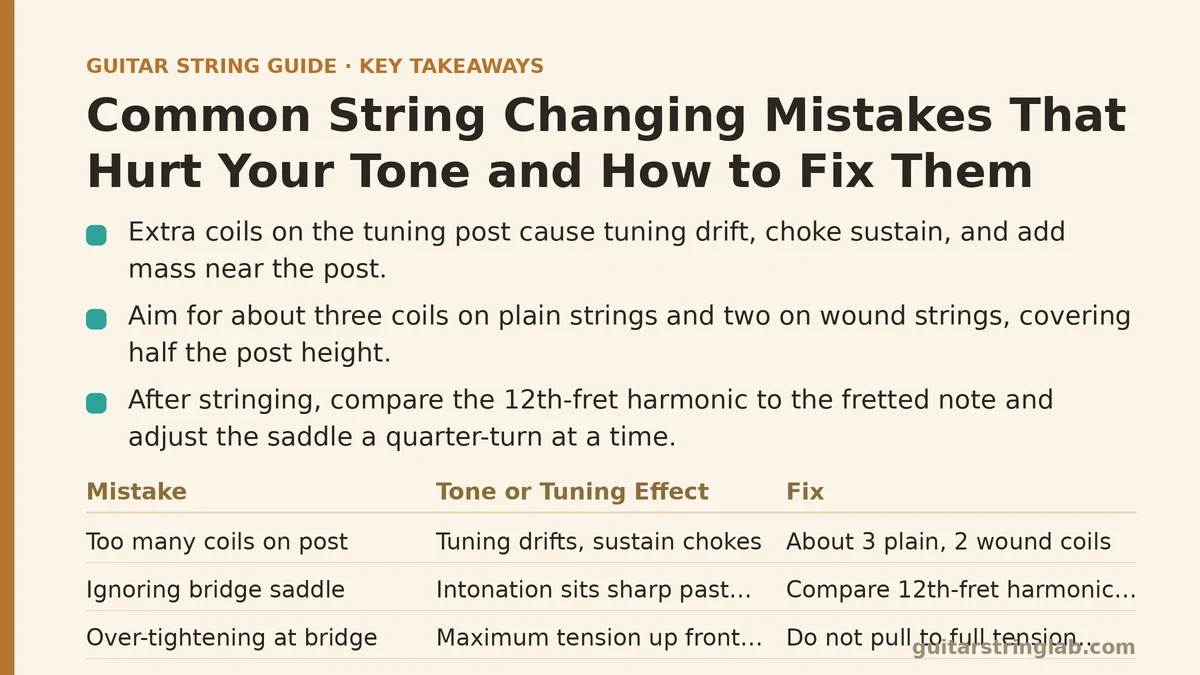
Myth: More Coils on the Tuning Post Means More Grip
Some players wrap four or five coils around the post, thinking the extra friction keeps the string locked. They tighten, tune up, and everything seems fine for a night. Then the tuning drifts within a week, and the tone at the nut takes on a slightly hollow character.
Reality: The tuning post grips the string at the pinch point where it exits the hole — not through the number of coils. On most guitars, one wrap above the hole and one below is sufficient. Extra coils stack on each other and slip microscopically during bends, which is why tuning walks after aggressive playing. They also add mass near the post that chokes sustain.
The fix: Cut the string about two tuning pegs past your target post, thread it through, and pull it taut. Hold that tension and start winding. Aim for roughly three coils on the plain strings and two on the wound strings, covering about half the post’s height. If you end up with five coils, snip and start over — forty seconds of work that saves a week of drift.
Myth: The Bridge Saddle Isn’t Part of the String Change
Plenty of players change strings and leave the bridge untouched, treating the saddle as a static part of the guitar that only matters during a full setup. They string up, tune to pitch, and notice the intonation sits slightly sharp past the fifth fret.
Reality: When intonation was last set, it was set with a different set of strings on the guitar. Even the same gauge from a different brand can have marginally different core-to-wrap ratios, which changes where the string’s speaking length should end. Swap from a 0.010 set with a round core to a 0.010 set with a hex core, and the intonation offset can shift enough to be audible above the twelfth fret.
The fix: After stringing all six and stretching them, compare the harmonic at the twelfth fret against the fretted note at the twelfth fret. Fretted note sharp? Move the saddle back from the nut. Fretted note flat? Move it forward. A quarter-turn of the saddle screw at a time is enough. Do this before trusting the guitar for anything requiring melodic accuracy above the fifth position.
Myth: Locking the String at the Bridge Means Pulling It as Tight as Possible
Electric guitars with through-body string mounts or locking tuners invite a certain overconfidence. Players pull the string as taut as humanly possible at the bridge before winding, figuring maximum tension up front means maximum stability later.
Reality: Pulling the string to full tension before winding begins places the core under stress before it has settled into its natural bend radius around the bridge saddle or tuning post. That pre-stressed string is more likely to develop a kink at the saddle over time, and kinks are where plain strings snap during gigs.
The fix: The string should be snug at the bridge — no visible slack, but no strain either. You should be able to push it laterally at the midpoint of the scale length by about half a centimeter without feeling resistance. That’s the right starting tension. Real tuning stability comes from stretching the string after winding, not from pulling hard before it.
Myth: Stretching Strings Once After Restringing Is Enough
New strings stretch as their cores settle under tension. Most players give them one firm tug per string, tune back up, and call the job done. By the second practice session, the guitar is drifting ten to fifteen cents flat within minutes of tuning.
Reality: A fresh string can take three to five stretch-and-tune cycles before the core stops elongating. A single pull distributes slack along the length, but the metal needs repeated tension cycles to seat fully against the nut slot, saddle, and post. Each cycle should be deliberate — grip the string at the twelfth fret, pull it away from the fingerboard by roughly an inch, and release.
The fix: After winding all six strings to pitch, stretch each one individually, then retune the whole guitar. Repeat that sequence until a second consecutive stretch-and-tune pass yields less than a two-cent drop on any string. On most sets of strings, that lands between three and five full passes. This adds about four minutes to your restringing job and removes tuning drift for the entire life of that set.
Myth: Winding Direction Toward the Post Hole Is Always Correct
It seems intuitive that the string should exit the tuning post hole in the direction that wraps toward the center of the post. But on guitars with staggered peg heights, or when the string approaches the post at an angle, that intuitive direction can create a sharp bend right at the hole exit.
Reality: A sharp bend at the hole exit concentrates stress and produces a weak point where strings often break first. The ideal path has the string leaving the hole and making one clean, gradual turn around the post. If the string exits at a steep angle toward the top of the post, you can get an S-shaped kink that fatigues the metal quickly.
The fix: When you insert the string end into the post hole, let the string’s natural approach angle guide which side of the hole faces the center of the headstock. Push the string through until it emerges, then bend it sharply back in the direction of the winding — a clean right angle at the hole. A distinct kink at that point is correct. It’s the curved, half-hearted angle that causes problems down the road.
Myth: Wipe Down and Move On — The Nut Slot Never Needs Attention
Players wipe strings clean after each session, check for rust, and consider maintenance done. The nut slots go unexamined unless a string breaks at the headstock end.
Reality: Over years of string changes, nut slots accumulate residue — dead skin cells, sweat salts, and microscopic metal dust from the strings themselves. That residue adds friction where the string crosses the nut. The result shows up as sticky tuning, particularly when you use the whammy bar or do aggressive bends, and as a subtle loss of clarity on the plain B and high E strings.
The fix: Every third or fourth string change, take a folded piece of 400-grit sandpaper or a purpose-made nut file and gently run it through each slot two or three times in one direction only. This dislodges packed residue without widening the slot. Test the string’s action in the slot — it should move freely when you pull it upward at the first fret. Any resistance at all means you missed some residue or the slot is binding.
The Fastest Path to Cleaner Tone
| Mistake | Symptom | Time to Correct |
|---|---|---|
| Excess coils on the post | Tuning drift during bends | 45 seconds per string |
| Skipping intonation check | Sharp/flat fretted notes above the 5th fret | 3 minutes with a tuner |
| Over-tightening at the bridge | Sudden string breakage at the saddle | 15 seconds per string |
| Single stretch pass only | Persistent drift in first two sessions | 4 extra minutes per restring |
| Poor winding angle at post hole | Breakage right at the tuning post | 20 seconds per string |
| Ignoring nut slot residue | Sticky tuning, muted high strings | 5 minutes every 3rd change |
Players who get consistent tone from one string change to the next aren’t doing anything exotic. They cut precisely, stretch thoroughly, and check the mechanical interfaces — the nut and the saddle — where most of the tone loss happens. Done all at once, those checks add roughly fifteen extra minutes to a restringing job.
Your next string change is the moment to apply this. String the guitar today, and before you retune for the third time, check the coils on each post, do one full intonation pass, and work each string through two proper stretches. The guitar will hold tune through the first heavy practice session, and your tone will stay clean across the full life of the set.
Which of these mistakes has shown up in your last few string changes? Describe your usual restringing routine — including how long you stretch — and the step most likely to be costing you tone right now can be identified.
Related guides: How to Change Electric Guitar Strings, First-Time Guitar String Change, and How to Stretch New Guitar Strings.