A guitar that sounds perfect in a climate-controlled bedroom often falls apart on the third night of a tour — and the cause is rarely the guitar itself. It’s the setup. A neck that was straight at 45% relative humidity in a studio can bow noticeably after a night in a humid club, or dry out and buzz after a long drive through a desert climate. For session musicians and touring techs, a setup isn’t a one-time event. It’s an ongoing responsibility that changes with the room, the season, and the setlist.
This guide answers the questions that come up most often when players start treating setup as part of the job rather than a hobby project.
What Makes a Setup Different for Session and Touring Work?
A bedroom setup optimizes for feel in one fixed environment. A professional setup optimizes for consistency across many unpredictable environments.
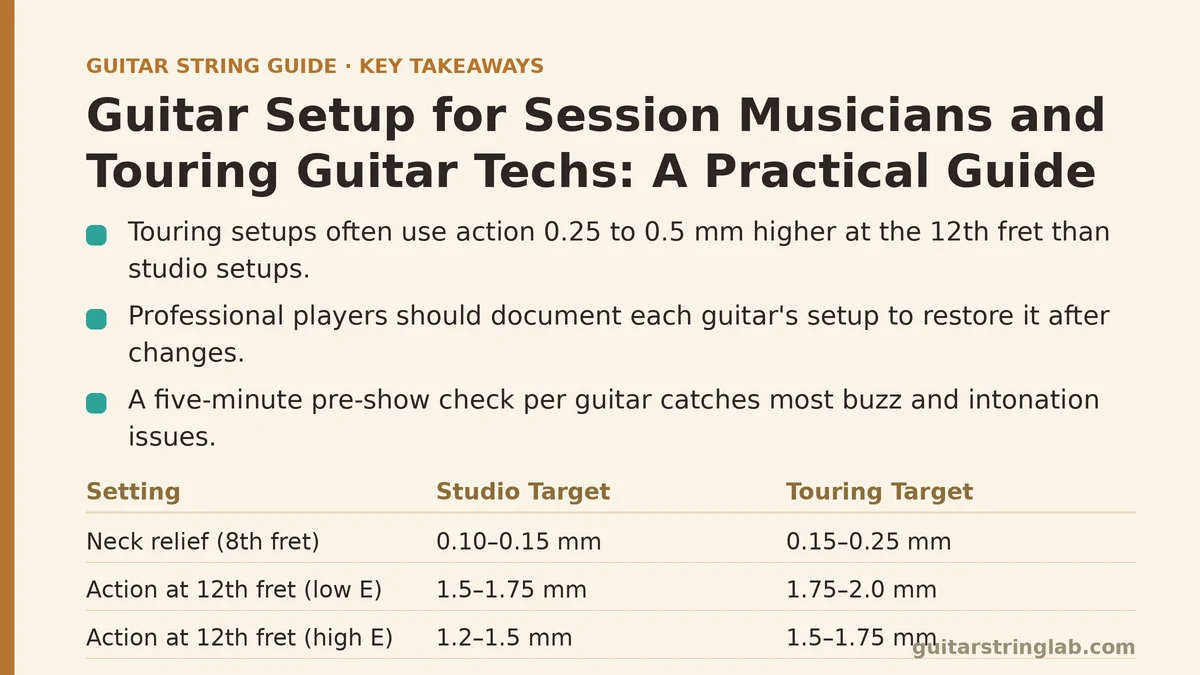
That means the target numbers shift. Instead of chasing the lowest possible action, a touring setup usually lands slightly higher than a studio setup — often by 0.25 to 0.5 mm at the 12th fret — to survive temperature swings, aggressive stage playing, and the occasional heavy-handed monitor engineer who wants the guitar loud in the wedge. Action that’s too low will buzz once the neck moves a fraction of a millimeter.
The other shift is documentation. A session player who shows up with three guitars needs to know exactly what each one is set to, so a mid-session tweak doesn’t drift into unfamiliar territory. A touring tech needs that same record to restore a guitar after a broken string, a dropped instrument, or a sudden humidity change.
How Do I Choose Setup Numbers for Stage vs. Studio?
Think of setup as three adjustable axes: relief, action, and intonation. Each has a range that works for most players, and a narrower range that works for professional consistency.
| Setting | Studio Target | Touring Target | Why They Differ |
|---|---|---|---|
| Neck relief (8th fret) | 0.10–0.15 mm | 0.15–0.25 mm | Slightly more relief absorbs humidity shifts and heavier pick attack |
| Action at 12th fret (low E) | 1.5–1.75 mm | 1.75–2.0 mm | Higher action resists buzzing when the neck moves |
| Action at 12th fret (high E) | 1.2–1.5 mm | 1.5–1.75 mm | Same logic, scaled down for the lighter string |
| Intonation | Set at pitch, 12th fret harmonic vs fretted | Re-checked every 2–3 shows | Temperature and string stretch both shift intonation |
These numbers are starting points, not rules. A jazz player with a light touch might tour at 1.5 mm action and never buzz, while a punk rhythm player might need 2.2 mm to survive a full set. The right number is the one that holds up under your playing, in your rooms.
What Should I Check Before Every Show?
A pre-show check takes about five minutes per guitar and catches most issues before they become mid-set problems.
Work through this list in order:
- Tune to pitch, then stretch each string. Even on a guitar that was cased overnight, strings relax. A single firm pull at the 12th fret per string, followed by retuning, removes most of the drift.
- Play a chromatic run from the open low E to the 12th fret. Listen for buzz. If a single fret buzzes, note which one — it tells you whether relief or action needs adjusting.
- Check intonation at the 12th fret on the two outside strings. A quick harmonic-vs-fretted comparison catches shifts before the audience hears them.
- Inspect the nut slots and bridge saddles for grime or burrs. A dirty nut slot will show up as sticky tuning during bends.
- Tune down a half step and back up. This settles the string tension against the nut and saddles and reveals any points that are binding.
If a guitar fails step 2 or 3, decide whether to fix it now or swap to a backup. On tour, the backup is almost always the faster answer.
How Many Backup Guitars Does a Touring Player Need?
The honest answer depends on set length and how hard the guitar is being used.
- Short club set (45–60 minutes), light playing: one primary plus one backup is usually enough.
- Full headline set (90+ minutes), heavy strumming or bending: two backups is standard. The second backup covers a broken string on the first backup, or a string break during an encore.
- Festival or TV slot with a hard stop: three guitars ready to go, with at least two already tuned and checked.
The real cost isn’t the guitars. It’s the setup time. A backup that hasn’t been intonated since the last tour is not a backup — it’s a problem waiting to happen. Budget 15–20 minutes per guitar to bring a stored instrument up to show-ready condition.
What Breaks Most Often on the Road, and How Do I Fix It Fast?
Four failures cover the vast majority of on-the-road setup problems.
String breakage at the tuning post. Usually caused by too many coils or a sharp bend at the post hole. Fix: unwind, cut two pegs past the target post, thread and wind again with one wrap above the hole and one below. Takes about 90 seconds.
Tuning drift after bends. Almost always a nut slot that’s binding. Fix: loosen the string, run a folded piece of 400-grit sandpaper through the slot two or three passes in one direction, restring, and test. If you don’t have sandpaper, a graphite pencil rubbed into the slot will get you through the show.
Buzz on one fret after a climate change. Relief has shifted. Fix: a quarter-turn on the truss rod, wait ten minutes for the neck to settle, then recheck. Turn counterclockwise (loosening) to add relief if the buzz is in the middle of the neck; turn clockwise if the buzz appears near the nut.
Intonation drifting sharp above the 12th fret. The saddle has moved, often because the string was stretched unevenly. Fix: check the 12th fret harmonic against the fretted note, and adjust the saddle screw a quarter-turn at a time until they match within a few cents.
None of these require a full setup. They’re all five-minute fixes if the tech knows the guitar’s baseline numbers.
What’s the Difference Between a Studio Setup and a Stage Setup in Practice?
Studio work rewards precision. You can hear every fret buzz and every cent of intonation error on a close-miked track. A studio setup usually sits at the lower end of the action range, with relief dialed in tightly and fresh strings on the guitar.
Stage work rewards stability. The tradeoff is that the guitar feels slightly stiffer to play, and intonation is checked more often because the environment changes more. A stage setup is not a “worse” setup — it’s a setup optimized for a different set of failure modes.
If you split your time between both, the practical approach is to keep one guitar set up for studio precision and one set up for stage durability. Trying to make a single guitar do both well in the same week usually means it does neither well.
How Often Should a Touring Guitar Get a Full Setup?
A full setup — relief, action, intonation, nut and saddle check, fret polish if needed — every 8 to 12 shows is a reasonable cadence for a guitar played nightly. Guitars played less often can go longer.
The signals that you’re overdue:
- You’re adjusting the truss rod more than once a week.
- Intonation drifts within a single set.
- The guitar feels noticeably different from the previous show.
- String changes are taking longer because the nut or saddles are resisting.
When two or more of these show up, stop patching and do the full setup. It’s usually a 30–45 minute job, and it prevents the slow drift that turns a familiar instrument into an unpredictable one.
Session & Tour Setup Baseline Card
Copy one row per guitar onto an index card or phone note—techs and session players use this to restore a instrument after a swap, drop, or climate shock.
| Field | Record here | Why it matters |
|---|---|---|
| Guitar ID (color, model, #1/#2) | Backups get mixed up fast backstage | |
| Relief (capo 1st fret, measure ~8th fret gap) | Studio: _____ mm / Tour: _____ mm | First adjustment when buzz appears mid-tour |
| Action @ 12th low E / high E | Studio: _____ / _____ mm / Tour: _____ / _____ mm | Touring targets are usually slightly higher |
| String set & gauge | Gauge changes need truss/action follow-up | |
| Last full setup (date or show #) | Triggers the 8–12 show full-setup cadence | |
| Pre-show pass (date) | Tune → stretch → buzz check → 12th intonation | Five-minute ritual before doors |
| #1 likely failure | String break / nut bind / relief buzz / intonation | Drives spare strings, graphite, rod wrench in the kit |
If post-show notes differ from the card by more than one quarter-turn on the truss rod or 0.25 mm action, update the card before the next travel day—drift compounds across a week of vans and clubs.
What Should I Do Today?
Pick one guitar — the one you play the most — and answer three questions honestly.
- What are its current relief, action, and intonation numbers? If you don’t know, measure them. A cheap string action gauge and a tuner will get you there in ten minutes.
- Which of those numbers would you change if you were about to play a 90-minute set tonight?
- What’s the single failure most likely to end your next performance — a broken string, tuning drift, or a buzz?
Write the answers down. That’s your baseline. Every future setup, whether at home or on the road, gets compared against it. A setup log that fits on a single index card per guitar is worth more than a shelf of tools — because the goal isn’t to own the perfect setup. It’s to know exactly what your guitar is doing, on any stage, on any night.
Related guides: String Gauge Guide for Touring Musicians, How to Change Electric Guitar Strings, Guitar Intonation Problems: Common Causes and How to Fix Them, and Guitar String Buzzing at the Nut vs Bridge.