Recycling guitar strings means routing six small pieces of metal alloy — steel cores with nickel, bronze, or brass wraps, plus a polymer layer on coated sets — through a disposal stream that can actually recover them, rather than through curbside bins built for rigid containers. The materials are recoverable in principle. The practical obstacles are volume, tangling, and the fact that most municipal sorting systems have no category for flexible wire.
| Disposal Route | Best For | Coated Strings? | Cost/Effort | Key Limitation |
|---|---|---|---|---|
| Curbside recycling | Rigid containers only | No | Free | No category for flexible wire |
| Mail-in programs (e.g. D’Addario Player Circle) | Players anywhere | Only if program states it | $1.50–$5 postage | Postage exceeds scrap value |
| Independent collectors | Aggregated small volumes | Varies | Shipping cost | Depends on collector |
| Household trash | Coated strings with no program | Yes (fallback) | Free | Metals not recovered |
| Scrap metal buyers | Bulk non-ferrous metal | No | Low value per set | 3–15 cents per set |
Step 1: Identify Your String Metals Before You Recycle Anything
Every disposal option depends on what your strings are made of. Check the packaging of the set you are replacing, or look at the silk wrapping near the ball end for the material code.
Six-string electric and acoustic sets typically include:
- Plain steel strings — the unwound first and second strings. High-carbon steel, sometimes with a tin or nickel plating.
- Nickel-plated steel wound strings — the majority of electric sets. Steel core, nickel-alloy wrap wire.
- Pure nickel wound strings — common in vintage-style electric sets. Nickel-alloy wrap over a steel core.
- Phosphor bronze wound strings — standard for acoustic sets. Copper-tin alloy wrap wire over a steel core.
- 80/20 bronze wound strings — another acoustic option. Copper-zinc alloy wrap.
- Coated strings — any of the above with a polymer layer (PTFE, polyurethane, or similar) applied to the wrap wire.
- Flatwound strings — similar alloys, but with a ground and polished outer surface.
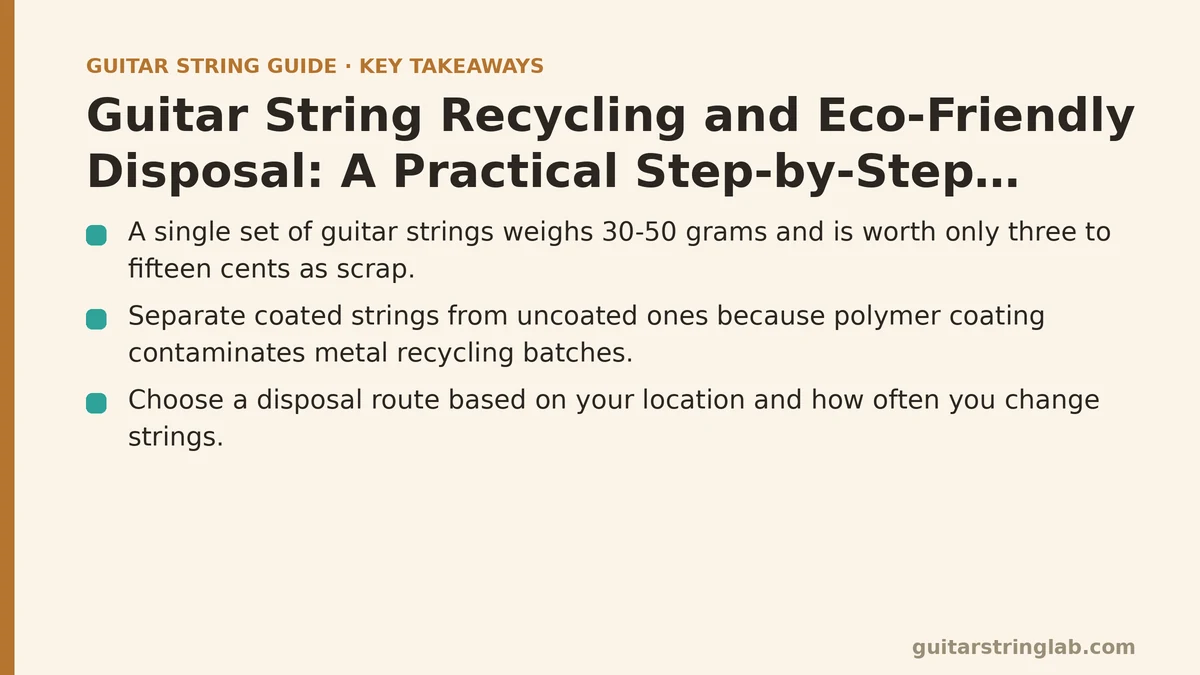
The steel cores in all these sets are recyclable in principle. The wrap materials are non-ferrous alloys with scrap value. Volume is where it falls apart. One set weighs roughly 30 to 50 grams. Scrap metal buyers pay around $0.50 to $1.50 per pound for mixed non-ferrous metal — so a single set is worth roughly three to fifteen cents. Pure nickel carries slightly more value per pound than bronze, but in both cases the weight is so low that shipping alone costs more than the material is worth. Cash is not the goal. Keeping these metals in circulation through programs that aggregate small volumes from many players is.
Step 2: Separate Coated Strings From Uncoated Ones
A coated string belongs in a different waste stream than a bare metal one. The polymer coating — typically a few microns thick — contaminates metal recycling when mixed with uncoated scrap. Depending on the facility, a small amount of coating from one string set can render an entire batch of otherwise clean nickel alloy unsuitable for high-grade reuse. Most dedicated guitar string recycling programs that accept coated strings either strip the coating chemically or send the strings to a facility that tolerates polymer contamination. Curbside programs have neither capability.
The rule is simple: if the string has any visible coating, or if the packaging says “coated,” keep it apart from your uncoated strings. Do not combine them even in the same envelope for mail-in programs unless that program explicitly states it accepts coated strings. If no program in your area takes coated strings, they go in regular household trash. The polymer layer makes them non-compostable and non-curbside-recyclable, but their steel content is still scrap — see the next step for a fallback.
Step 3: Choose Your Disposal Path Based on Where You Live
Three main routes exist, and the right one depends on your location and how often you change strings.
Route A — Mail-in recycling programs. The most reliable option for players anywhere. Several organizations accept guitar strings by mail: D’Addario’s Player Circle program, along with independent collectors who aggregate strings for scrap recovery. The process is uniform across these services: gather your used strings, coil them loosely (Step 5 covers the correct method), place them in a padded envelope or small box, and ship them to the provided address. You pay postage, which runs $1.50 to $5 depending on weight and distance. Some programs issue store credit or discount codes after a certain volume; the D’Addario program gives loyalty points redeemable for strings and accessories. A player who changes strings every two months on a single guitar accumulates about 12 sets per year — enough volume to make shipping worth the effort, particularly if two or three years’ worth go out in one box.
Route B — Local music store drop-off. For zero shipping cost, call your two or three nearest independent guitar shops and ask whether they run a string recycling bin. Roughly one in five independent shops currently participates in a mail-in program on behalf of customers. Big-box retailers rarely do, but check anyway. The drop-off bin empties at irregular intervals — anywhere from monthly to quarterly — so expect your strings to sit in the shop for a while before they are aggregated and shipped out. This route works best when the shop displays a program name, such as D’Addario’s, so you know your strings are heading somewhere legitimate rather than straight to a landfill.
Route C — Household trash, as a last resort. If neither A nor B is available in your region and the postage is not justifiable, uncoated strings can go in your regular trash. They will sit in a landfill indefinitely — steel and nickel alloys do not biodegrade, but they also do not leach hazardous substances at concentrations that concern regulators. Coated strings add a polymer layer that similarly stays inert. Not the responsible choice, but not an actively harmful one either. The better move is to save strings for six months to a year and ship a batch, because the marginal cost of adding five extra sets to one envelope is near zero.
Step 4: Understand What You Cannot Do With Old Strings
One recycling myth circulates constantly in guitar forums, and it needs to end here. No guitar string is compostable. Even the bronze or phosphor bronze wound sets are alloys, not organic material. Thin steel wire in a compost pile will not break down over any practical timeframe, and the coating on coated strings is a petroleum-based polymer that will persist in soil indefinitely.
Public metal recycling bins outside supermarkets and scrap yards are also off-limits. Those bins accept aluminum cans and beverage containers specifically. Any steel or nickel wire in that bin contaminates the load and may cause the entire bin’s contents to be rejected by the scrap dealer. One single steel string in an aluminum can recycling bin can cause a 200-pound load to pay at the lower mixed-metal rate instead of the clean aluminum rate — a measurable financial hit for the recycling operator, and a reason they will not thank you for it.
Never burn old strings. The zinc in brass and bronze alloys vaporizes at high temperatures, releasing zinc oxide fumes that cause flu-like symptoms. The nickel in many electric strings poses a similar inhalation risk. Municipal waste incinerators operate hot enough and control emissions adequately to handle small quantities, but backyard fire pits and wood stoves do not. Keep strings out of any fire.
Step 5: Prepare Your Strings for Recycling the Right Way
Tangled strings are the single biggest problem recycling programs report. A tangle makes your envelope bulky and hard to process, and it risks puncturing the envelope or snagging on sorting equipment. Here is a method that works:
- Do not coil the string tightly around your hand. That creates a spring someone has to fight to unwind.
- Hold the string at the ball end. With your other hand, wrap the string loosely around four fingers to form a loop roughly three to four inches in diameter.
- Slip the loop off your fingers. Wrap the remaining free length of the string two or three times around the bundle to hold it in place, then thread the loose end through the bundle’s center loop once to lock it.
- Place all six strings in a single reusable zip-top bag. If you have separates, keep the bag labeled “coated” or “uncoated.”
- Check the program’s size limits. Most mail-in programs accept multiple bundles in one envelope up to a certain weight. Six sets of six strings weigh roughly 200 to 300 grams, which ships as a small parcel at economy rates. Weekly restringing for a year produces around 52 sets — that fills a shoe box and weighs about two and a half pounds. Ship in two parcels if the program caps weight below that.
Wipe excess dirt and oil off the strings before packing. Solvent degreasing is unnecessary — dry wiping with a cloth removes the bulk of residue that can make your envelope sticky or attract pests en route. Do not wash strings with water, as that accelerates oxidation and makes the metal surface contaminate other scrap.
Step 6: Decide Whether Recycling Is Worth the Effort for You
This is a cost-benefit decision, not a moral one. The numbers: a six-string set weighs 30 to 50 grams. Mail-in postage for a single set runs $1.50 to $3. Store credit programs return roughly $1 to $2 in loyalty value per set, meaning a D’Addario player breaks even. Players of other brands pay the postage outright. Local drop-off costs nothing but up to 15 minutes of travel time, plus waiting until the shop empties its bin.
Change strings monthly for a year and recycle through a drop-off shop, and the environmental impact is modest but real: roughly half a kilogram of nickel, steel, and bronze kept out of landfill. Change strings twice a year and that drops to a hundred grams — about the weight of a smartphone. Neither is a world-changing act, but both are more than zero. Consistency is the decision that matters most. A single set shoved in the trash every three months adds up to a kilogram of alloy waste over a decade. Recycling those same sets through a local drop-off program costs ten minutes per trip.
Step 7: Build a Sustainable String Habit From the Start
The easiest string to recycle is the one you never have to — but for most players, that is not a realistic goal. Coated strings last two to three times longer than uncoated equivalents in the same conditions, which means one third to one half the disposal events per year. Play daily and change uncoated strings every three weeks, and switching to coated pure nickel or nickel-plated steel extends that interval to six to nine weeks. That is a 60–70 percent reduction in annual string waste, without changing your tone perceptibly for most players.
For your next restring, keep a dedicated container near your guitar stand — a tin can with a lid works well. Every time you change strings, put the old set in that container with a small piece of paper noting the date and whether it was coated. When the container fills to about two pounds, ship it or bring it to a participating shop in one trip. That single batch costs the same postage as one set shipped alone, and it removes the temptation to toss a single set in the trash because it is not worth a trip.
The Two-Minute Plan You Can Do Today
Pull the old strings off your guitar, wrap them loosely as described, and put them in a zip-top bag. Write “uncoated” or “coated” on the bag. Then check D’Addario’s Player Circle site for the current mail-in address, or call the two guitar shops nearest you and ask if they run a string recycling bin. Set a reminder on your phone for the date you plan to ship your batch — six months out if you only restring occasionally, three months if you restring monthly. When the date arrives, put the bag in a padded envelope, address it, and drop it at the post office. Done.
How often do you change strings, and which recycling route — mail-in, shop drop-off, or trash — is currently closest to you? Tell me your restringing frequency and location, and I will help you pick the disposal path that gets used rather than the one that sounds best in theory.
Related guides: Guitar String Storage Tips, String Rust and Corrosion Prevention, and How Long Do Guitar Strings Last.