Most players believe that a factory-sealed pack of guitar strings stays fresh on a shelf indefinitely. It doesn’t. The packaging slows oxidation and corrosion, but it never stops them — and the warmer and more humid the room where your spares live, the faster a sealed set degrades before it ever touches your guitar.
A set that sat in a hot, damp drawer for eight months can sound dull, feel gritty, and lose tuning stability within its first week of use. That isn’t a defective product. It’s a storage failure. The metal began reacting with moisture and air the moment the factory sealed the packet, and the conditions around it determined how quickly that reaction played out.
Here’s how to store spares so they play as fresh as the day they were made, and what to do if you already have a compromised set in your collection.
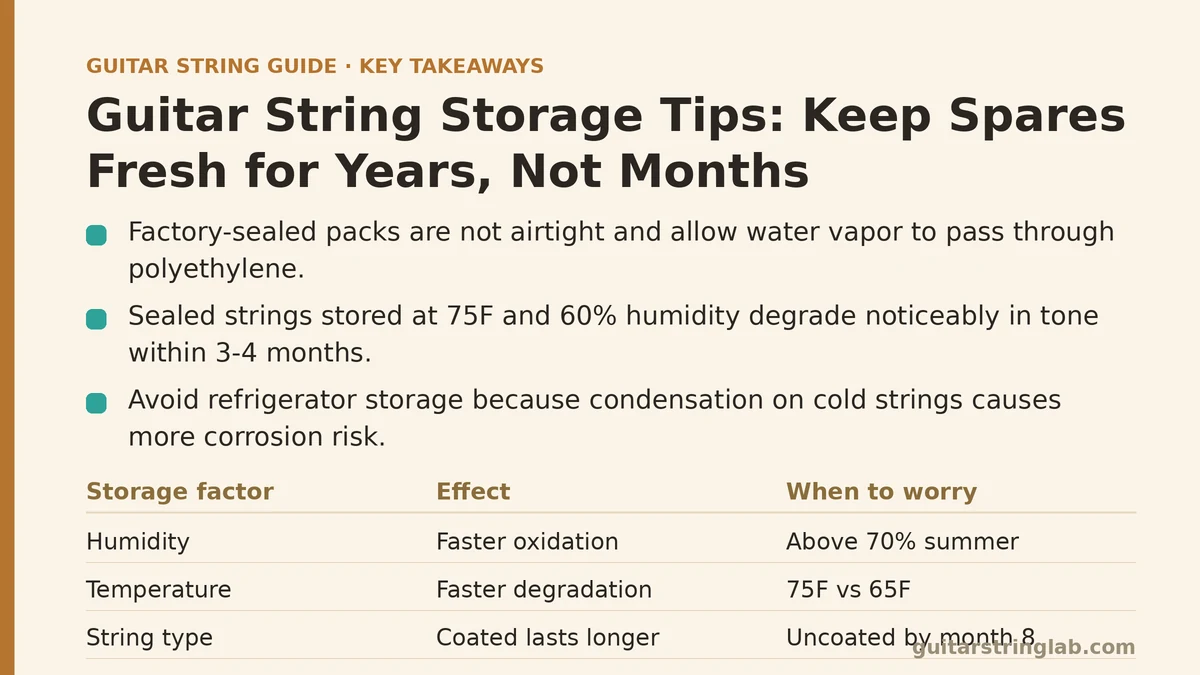
Myth: The Factory Packet Means the Strings Are Sealed Against Everything
Manufacturers use sealed plastic wrappers with arrows indicating the string order. It looks airtight and permanent. In practice, most packets are a single thin layer of polyethylene — a material that lets water vapor pass through slowly over time. It’s not a vacuum seal and it’s not a moisture barrier.
Reality: A sealed set stored at 75°F (24°C) with 60% humidity degrades measurably faster than the same set stored at 65°F (18°C) with 40% humidity. The difference becomes noticeable in tone within three to four months. If you live in a coastal area or anywhere summer humidity regularly tops 70%, the shelf life of a “sealed” set gets shorter still. Treat the packet as a transport container, not a long-term preservation vault.
Myth: The Fridge or Freezer Is a Good Place for Spare Strings
You might have heard this tip from a touring guitarist or read it in a forum thread. The logic goes that cold slows chemical reactions, so why not give strings a refrigeration vacation? It sounds reasonable until you think about condensation.
Reality: Every time you take cold strings out of the fridge or freezer, moisture from the air condenses on the packet, and if you open the packet while it’s still cold, that moisture goes straight onto the strings. One cycle of that can do more damage than a month of sitting on a shelf. Unless you’re willing to let the packet warm to room temperature inside a sealed container for two to three hours before opening it — and then keep the remaining strings cold again — refrigeration creates more corrosion risk than it prevents. Skip the cold. Control the humidity instead.
Myth: All Sealed Sets Degrade at the Same Rate
Browse any gear store and you’ll see coated and uncoated strings from several brands, all in similar-looking packets. The assumption is that storage needs are the same across the board. They are not.
Reality: Uncoated strings, especially pure nickel and nickel-plated steel, are far more vulnerable to oxidation than coated sets. The polymer coating on strings like D’Addario XS or Elixir works as a genuine barrier layer, slowing the moisture and air that reach the core wire and wrap. A coated set stored poorly at 50% humidity will still play acceptably after 12 months. The same storage for an uncoated set can produce visible dulling and a gritty fingerprint-feel by month eight.
Also consider the wrap material. Phosphor bronze and pure nickel dull faster than nickel-plated steel under identical conditions because of how the metal reacts with oxygen. If you play acoustic with phosphor bronze, your spare sets are the most perishable item in your gig bag.
Myth: A Dark Drawer or Closet Is Enough
Out of direct sunlight, away from radiators — players do this and assume the job is done. But temperature swings and humidity swings in a typical home, especially near external walls or basements, can be wider than you’d think.
Reality: The single most important factor is not darkness. It’s a stable, low humidity environment. A closet against an exterior wall in a house that fluctuates between 35% and 65% humidity across the seasons is a poor place for strings. The metal is constantly absorbing and releasing moisture, which accelerates micro-corrosion on the surface. A consistent 40–50% relative humidity is the safe zone. Above 60% is where trouble starts.
The Storage System That Works
Here’s a practical, low-budget approach that keeps spares playable for two to three years:
Step 1: Keep the strings in their original packet. Do not open it until you need them.
Step 2: Place the packet inside a resealable plastic bag, squeezing out as much air as possible. This adds a second moisture barrier on top of the thin factory layer.
Step 3: Store that bag in a sealed plastic container (a Tupperware or a dedicated parts box works) with one or two silica gel desiccant packets. These cost about $8 for a pack of 20 on any online retailer. Replace them every six months or when the indicator color changes, depending on the brand.
Step 4: Keep the container in a room whose temperature stays relatively stable — an interior closet, a bedroom shelf, or under a desk. Avoid garages, attics, basements, and anywhere near a bathroom or kitchen where steam is common.
Step 5: Label the container with the date you stored the strings and the date you opened them. If you have multiple open sets, note which guitar they’ll go on next. This prevents the “five loose strings but no idea which came from which set” problem.
That’s a total cost under $15 and about ten minutes of effort. It extends the usable life of uncoated strings by a factor of two or three in most homes.
What About Strings You’ve Already Opened?
An opened set is a different situation. Once the packet is open, the strings are exposed to the room’s air, and the clock runs faster. Even here, the same principle applies — control humidity, control temperature.
If you’ve opened a set and only used five strings, wrap the unused sixth string back in its original paper sleeve, place it in a resealable bag with a desiccant packet, and store it flat. It won’t last as long as a fully sealed set, but it should stay playable for several months if the storage is good. If you notice any discoloration or a rough texture when you finally string it up, discard it and use a fresh one — a compromised string will not last a full week of playing.
How to Tell If a Stored Set Is Already Compromised
Before you string up a spare set that’s been sitting around, do a quick two-second check. Run the low E string between your thumb and forefinger along its entire length. A fresh string feels smooth and almost slippery. A degraded string has a faint grittiness or catches slightly on your skin.
Look at the color under a bright light. Dull patches, darker spots, or any faint rust tint on the wound strings mean the set has suffered. If it looks compromised, don’t put it on your guitar. You’ll save yourself the frustration of restringing twice.
When Storage Won’t Save You
No storage method saves a set that was already exposed to significant humidity before you bought it. If you bought strings from a shop that stores them in a damp back room, or ordered them from a warehouse that feels like a sauna in July, the degradation started before the packet reached your hands. That’s why buying spare strings in bulk from a high-turnover retailer makes sense — fresher stock. Or order from a dedicated string brand directly online, since they control their own warehousing climate.
| Storage Condition | Uncoated Set Shelf Life | Coated Set Shelf Life |
|---|---|---|
| Room temp, 50–60% humidity, open shelf | 3–5 months | 6–9 months |
| Sealed bag, 40–50% humidity, stable temp | 12–18 months | 24+ months |
| Sealed container with desiccant, stable temp | 24+ months | 36+ months |
| Fridge or freezer | Risky — condensation damage | Risky — condensation damage |
Use this table as a planning tool. If you gig regularly, you should have at least one spare set in your case and one spare set in your storage container. The case set gets replaced every six months, the storage set gets cycled into play whenever you open it.
What to Do Next
Check your spare strings today. If they’ve been sitting in a drawer or a gig bag for more than four or five months, do the finger test on a low E string. If it feels smooth, move them into the sealed-bag-and-container system above within the next day. If it feels gritty or looks dull, take the loss and restock — the $10–15 cost of a new set beats the hour you’ll waste installing dead strings and hating the tone for two weeks.
Once you have a proper storage setup, set a reminder to swap your guitar case’s spare set twice a year. That rotation alone keeps you from ever installing a set that was past its useful life.
How are you storing your spare strings right now, and have you ever installed a set that felt dead from the first day? Your storage situation determines whether your current approach will hold up through your next season of gigs or practice marathons.
Related guides: String Rust and Corrosion Prevention, How Humidity Affects Guitar Strings, and Guitar String Recycling Guide.