By the end of this guide, you’ll know how altitude changes air pressure, why that pressure shifts your tuning, and what practical steps to take so your guitar stays stable from sea level to the mountains. A guitar at sea level and the same guitar at 8,000 feet are not tuned to the same pitch, even if the tuner says otherwise. One sits under roughly 14.7 pounds of atmospheric pressure per square inch; the other sits under closer to 10.5. That difference doesn’t just affect your ears — it changes the physical behavior of the strings, the neck, and the bridge in ways that can make a perfectly set-up instrument feel like a different guitar.
Most players blame temperature or humidity when their tuning drifts during a mountain trip. Temperature and humidity matter, no question. But air pressure is its own variable, one that acts on your strings whether you’re playing an outdoor festival in Denver or a pressurized cabin at 35,000 feet. Understanding what it does, and separating it from the other environmental factors, is the first step toward keeping your guitar stable wherever you take it.
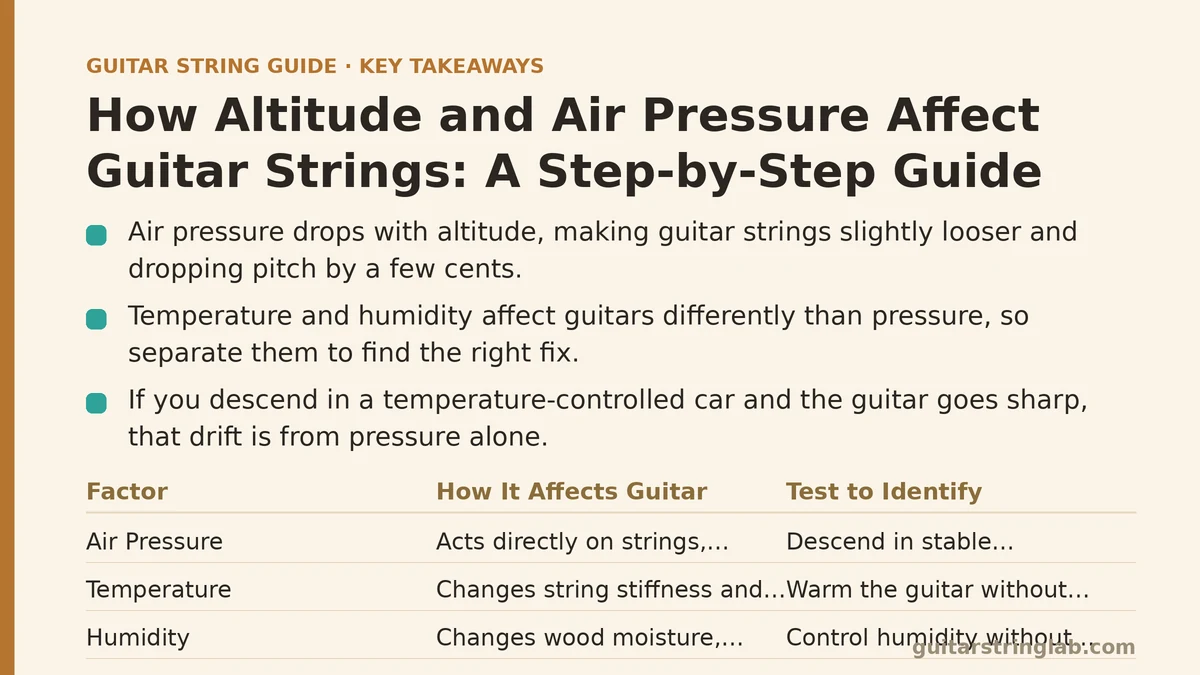
Step 1: Understand What Air Pressure Does to String Tension
Air pressure pushes inward on everything it touches, including your strings. At sea level, that inward push is significant — roughly enough to slightly compress the string’s path between the nut and bridge. Climb in altitude and that pressure drops. The air push weakens, and the string becomes, for all practical purposes, slightly looser.
The change is small in absolute terms. A typical .010–.046 electric set at standard tuning has a total tension around 90 to 100 pounds. Dropping from sea level to 10,000 feet reduces the compressive force by roughly two pounds per square inch across the string’s surface area. Since the string’s cross-section is tiny, the net relaxation is a fraction of a pound — enough to drop pitch by a few cents, not by a semitone.
That few-cents drift matters more than you might think when you’re playing with others. A guitar that’s five cents flat against a keyboard that stays locked at A440 stands out in a mix. If you’re recording, that same drift shows up in the time-aligned waveforms. The fix isn’t retuning once — it’s understanding that the drift will recur as pressure changes around you.
Step 2: Separate Pressure Effects from Humidity and Temperature
Air pressure rarely travels alone. As you change altitude, temperature swings and relative humidity shifts come along for the ride. Each one affects your guitar through a different mechanism, and confusing them leads to the wrong solution.
Temperature changes string stiffness and the wood’s dimensional stability. A cold guitar drifts flat because the metal contracts and the neck slightly bows. Humidity changes the wood’s moisture content, which expands the top and shifts the bridge. Pressure acts directly on the strings themselves, independent of the wood.
Here’s the practical test: if you tune up at elevated altitude and then descend while keeping the guitar in a temperature-controlled car, you’ll hear the guitar go sharp as pressure rises. That’s pure pressure, no temperature involved. If you see the opposite — flatter at lower altitude — something else is at play, likely moisture in the wood.
Step 3: Recognize When Pressure Effects Are Big Enough to Matter
There’s no universal altitude threshold where strings suddenly detune. The effect builds gradually, but it becomes noticeable around 3,000 to 4,000 feet of elevation change in side-by-side A/B testing. At 5,000 feet, most players with decent ears can hear a fresh set of strings sit a few cents flat after tuning at sea level.
The magnitude varies with string gauge and scale length. Heavier strings have more total mass, so the same pressure change creates slightly more tension swing. A longer scale length (like a 25.5-inch Fender-style guitar) spreads that tension change across more string length, making the pitch drift slightly larger than on a 24.75-inch Gibson-style instrument. If you play both, you’ll notice the longer-scale guitar drifts a touch more.
For solo practice, a few cents is nothing — your ear adjusts. For live performance with a fixed backing track or a band that tunes to a keyboard, it’s a real problem. The same applies to recording, where even two or three cents of drift across a tracked guitar part can ruin doubling or create phasing artifacts.
Step 4: Handle the Altitude Tuning Procedure Correctly
When you arrive at a new elevation, resist the urge to tune immediately. The strings need time to reach thermal equilibrium with the local air, especially if the guitar came out of a car trunk or a heated case. A string that’s still warming up expands as it warms, drifting flat, then drifts sharp as the wood takes on the new ambient humidity. Tuning during that window gives you a moving target.
The practical sequence is this: let the guitar sit in the performance or practice space for at least 15 to 30 minutes, untouched. Then tune once, play for about ten minutes to let the strings settle into their new tension, and tune again. The second pass usually catches most of the drift. If you’re crossing several thousand feet of elevation, expect to repeat this once more after a couple of hours.
Do not stretch new strings immediately before an altitude change. Fresh strings go through their initial stretch phase during the first hour of playing, which produces more pitch drift than any pressure change ever will. Install new strings a day or two before your trip, play them in at your home elevation, and you separate the string-stretch variable from the pressure variable completely.
Step 5: Adjust Your Tuning Target to the Changing Air Column
At high altitude, air density drops, which means sound waves travel differently. The air itself becomes the medium your strings vibrate into, and a thinner medium offers slightly less acoustic resistance. The result: your guitar’s output becomes a touch quieter and slightly brighter on the top end, especially on the high E and B strings.
Players sometimes chase that brightness by tuning sharp thinking the guitar sounds dull. That’s a mistake. The tone change is subtle — in practice, noticeable only when comparing the same guitar at different elevations side by side — and over-tuning sharp compounds the pressure-induced flatness into a mess. Instead, tune to a fixed reference (your tuner or a keyboard) and trust that your ear will adapt to the local acoustic environment within a song or two.
Step 6: Address the Wood’s Response, Not Just the Strings
Air pressure changes don’t stop at the strings. The soundboard, braces, and bridge all react to the reduced atmospheric load. At altitude, the top expands slightly relative to the internal air inside the body, which is at higher pressure than the surrounding air. That creates a subtle upward belly behind the bridge and a corresponding change in the break angle across the saddle.
On most guitars, this is negligible. On lightly built acoustic guitars, particularly vintage or ladder-braced instruments, it can push the saddle height up enough to raise the action by a hair or two. If you feel increased buzzing at altitude, check the saddle seating and relief before blaming string tension. A quick quarter-turn of the truss rod relief can compensate, but always return that adjustment when you descend.
Step 7: Use Pressure as a Diagnostic Tool, Not an Enemy
Once you know how pressure affects your guitar, it becomes a reliable diagnostic. If you arrive at a gig and the guitar sounds lifeless, and you’ve already tuned to a reference, ask yourself what the elevation change was. If it was significant, the dullness is likely the air density, not your strings. Don’t change strings unnecessarily.
Conversely, if you’re at sea level and a guitar suddenly sounds dull for no reason, that’s not pressure — that’s string wear or a humidity spike. Pressure is a consistent, predictable variable. Use it to rule out the environmental causes that get misattributed to bad strings or poor setup.
A Quick Reference Table for Altitude Adjustments
| Elevation Change | Expected Pitch Drift (approx.) | What to Do |
|---|---|---|
| 0–3,000 ft | 1–2 cents flat | Retune after 15-minute settle |
| 3,000–6,000 ft | 3–5 cents flat | Retune twice, wait 30 min between |
| 6,000–10,000 ft | 5–8 cents flat | Let guitar acclimate 1 hour, retune, check for buzzing |
| 10,000+ ft | 8–12 cents flat | Consider a higher-tension string set if playing there often |
For players who regularly perform at a mix of elevations, a dedicated travel guitar with slightly heavier strings (one gauge up) reduces the relative impact of pressure swings. The heavier set holds pitch more firmly because the added mass shifts the tension-to-pressure ratio in your favor.
The Bottom Line
Air pressure alters your strings by a few cents, affects tone by a subtle but audible margin, and interacts with the guitar’s wood in ways that can change action. None of it is catastrophic, and all of it is manageable with a routine: acclimate, tune, play, and retune once. Keep that rhythm and you’ll stop being surprised by altitude entirely.
Related guides: How Humidity Affects Guitar Strings and Tone, Why Guitar Strings Go Out of Tune, and Guitar String Gauge Guide.