Two guitars can carry the same string gauge, sit in the same tuning, and still feel like different instruments under your fingers — one soft and springy, the other tight as a wire fence. That difference comes down to one measurement most players never think about: scale length.
Knowing how gauge and scale length interact turns string selection from guesswork into something you can reason through. By the end of this post, you will be able to look at any guitar with a known scale length, make a confident first guess at the right gauge range, and understand why a set that feels perfect on one instrument can feel like rubber bands or bridge cables on another. That saves money on wasted sets and hours spent fighting a guitar that feels wrong for reasons you couldn’t name.
The relationship between gauge and scale length is one of the most overlooked factors in string selection. Players routinely swap between guitars with different scale lengths and wonder why the same string set feels completely different, or why their setup suddenly goes out of whack when they change instruments. The tension math connecting these two variables explains every one of those experiences, and once you see the numbers, the pattern is hard to unsee.
Myth: Gauge Feels the Same on Every Guitar
Many players settle on a favorite gauge from one instrument and assume that same set is the right choice for everything else they own. A Strat player who loves 0.010s buys a Les Paul and strings it up with the same set, expecting an identical feel.
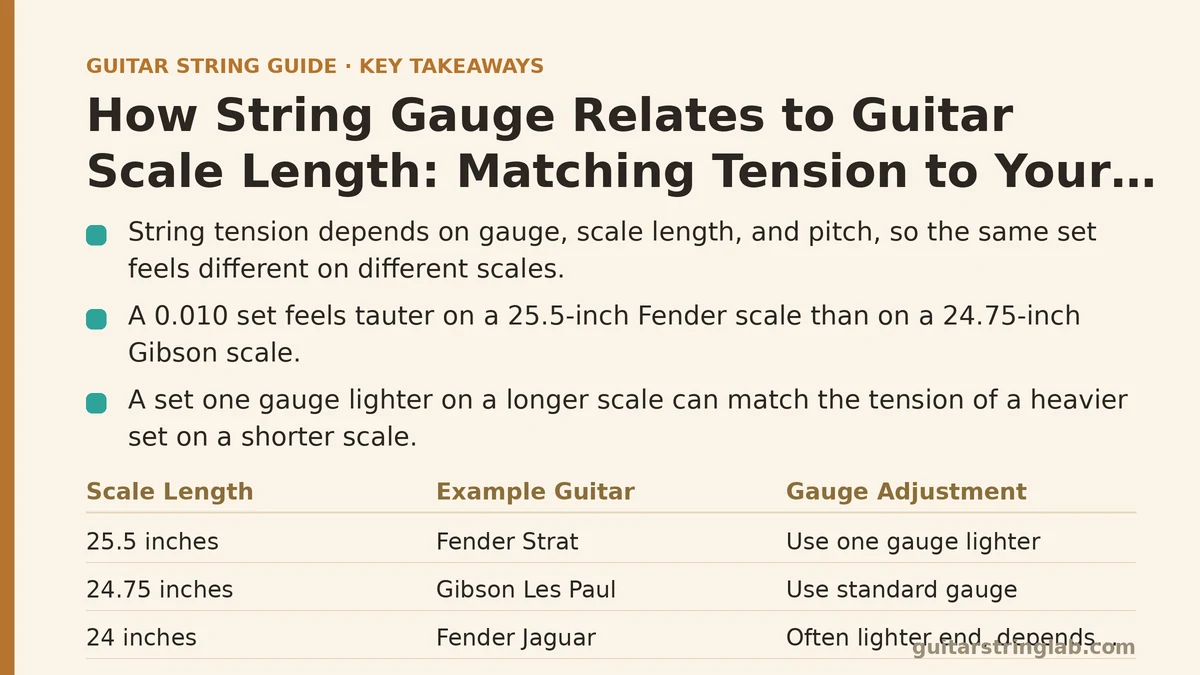
Reality: Tension comes from three things working together: gauge, scale length, and pitch. Scale length is the distance the string vibrates — from the nut to the bridge saddle — and a longer scale puts more physical stretch on the same string at the same pitch. An identical 0.010 set therefore feels measurably tauter on a 25.5-inch Fender scale than on a 24.75-inch Gibson scale. That difference is not subtle. In practice, players who move between these two common scale lengths often find that a set one gauge lighter on the longer scale lands in the same tension neighborhood as the heavier set they used on the shorter one.
Myth: Shorter Scale Lengths Always Need Heavier Strings
The reverse reasoning shows up in the other direction. Players with shorter-scale guitars assume they need thick strings to build enough tension, so they slap 0.012s on a 24-inch Jaguar and wonder why the neck feels tight and the bends fight back.
Reality: Tension is only part of the setup story. A shorter scale at the same tension produces less fundamental string stiffness, which changes how the string bends and responds under the fingers. Heavier strings on a short scale can compensate for slackness, yes, but they also push overall tension to a point that makes the instrument feel stiff in a different way. The goal is not maximum tension — it is finding the gauge where the string feels stable and responsive at whatever tension a given scale produces. On a short scale, that sometimes means going heavier than you would on a standard scale, but often it means the lighter end of what you might expect, depending on how the guitar is set up and how you play.
Myth: Scale Length Only Matters for Electric Guitars
Acoustic players often treat this as an electric-guitar concern, because they only hear scale length discussed in the context of Strats versus Les Pauls. That assumption skips over a big part of the picture.
Reality: Acoustic guitars vary in scale length as much as electrics do, and the same tension rules apply. A typical dreadnought runs around 25.5 inches, while many classical and smaller-body acoustics fall closer to 25.5 inches too, though some parlor guitars and travel acoustics drop well below that. Put medium-gauge bronze strings on a short-scale acoustic and you are asking for noticeably higher tension than the same strings on a standard dreadnought, and the instrument’s top and bracing have to handle that added load. Players who chase the same feel across two acoustics of different scale lengths usually end up changing gauge by one step to compensate.
Myth: Tension Charts Are Only for Luthiers
Tension tables look like engineering documents, so the average player skips them and relies on guesswork. That is a shame, because the useful information in those tables is surprisingly easy to read.
Reality: A standard tension chart lists gauge, scale length, and pitch, and outputs pounds of tension per string. You can find the tension for your current set on your current guitar, then search for a different gauge on a different scale length that lands in the same range. That is the single most reliable way to reproduce a feel you already like. If you love how 0.011s feel on a 25.5-inch scale, for example, you can locate a 0.012 set on a 24.75-inch scale that produces nearly identical tension per string. The math removes the guesswork from what would otherwise be trial-and-error across multiple expensive string purchases.
Myth: The Reference Note Is the Same, So the Feel Should Be the Same
The reasoning goes that a low E string is a low E string, so as long as the guitar is tuned to standard pitch, the string cannot feel that different from one instrument to the next.
Reality: The same pitch at the same gauge across a longer vibrating length means more physical displacement per cycle and more force required to deflect the string. Your fingers feel that directly. The string is not only under more static tension, it also resists bending and fretting differently because the geometry of the longer span changes how leverage works under your fingertips. This is why a guitar with a 25.5-inch scale and 0.010 strings can feel stiffer at the first fret than a 24.75-inch guitar with 0.011s, even though the longer-scale guitar is using lighter strings overall.
A Practical Tension Comparison Across Common Scales
The table below shows approximate tensions for a plain high E string at standard tuning across three common electric guitar scales. These numbers are representative, not exact, and will vary slightly by string brand and construction. They illustrate the pattern clearly enough to guide your next set purchase.
| Scale Length | 0.009 | 0.010 | 0.011 | 0.012 |
|---|---|---|---|---|
| 24.75" (Gibson-style) | ~13.5 lbs | ~16.5 lbs | ~20 lbs | ~24 lbs |
| 25.5" (Fender-style) | ~14.5 lbs | ~17.5 lbs | ~21.5 lbs | ~25.5 lbs |
| 27" (baritone, extended range) | ~16 lbs | ~19.5 lbs | ~24 lbs | ~28.5 lbs |
Read the table horizontally to see how scale length changes tension at a fixed gauge. Read it vertically to see how much you can compensate by shifting gauge. Moving from a 24.75-inch to a 25.5-inch guitar at the same gauge typically adds roughly one to two pounds of tension per string — enough to feel immediately different and enough to shift your setup out of its previous sweet spot.
Matching Gauge to Scale Length in Practice
Here is a set of starting points based on what tends to work consistently across a wide range of restringing situations. These are not rules, but they give you a sensible first move before you start fine-tuning.
Standard 25.5-inch scale electrics: 0.010 or 0.011 plain steel, depending on whether you prefer a standard or slightly stiffer feel. If you came from a shorter-scale guitar, start with the same gauge you used there and expect it to feel tighter. If that is too stiff, step down a gauge before you change your playing technique.
Short 24.75-inch scale electrics: 0.010 through 0.011 works well for most players, but if your previous set felt slinky to the point of instability, step up to 0.011 or 0.012 rather than blaming the guitar’s action.
Longer 27-inch scale and beyond: Drop the gauge one step below what you use on a standard scale. A player comfortable with 0.011 on a 25.5-inch scale should start around 0.010 on a 27-inch baritone to maintain a comparable feel. The added scale length does the tension work for you.
Acoustics under 25 inches: Consider the next gauge up from what feels comfortable on a dreadnought, but check the manufacturer’s recommended string range first. Some smaller-bodied acoustics are not braced for heavy tension and will sound choked or even develop issues over time.
What Setup Adjustments to Expect After Changing Gauge for Scale Length
Changing the gauge to compensate for a scale-length difference will not automatically produce a perfectly playing guitar. When you move to a different gauge, expect to revisit at least two setup points. The truss rod will need a check because the change in tension pulls or relaxes the neck arc. The bridge saddles or saddle height will likely need a small adjustment because the new string diameter sits differently in the nut and saddle slots, and the intonation will drift until you re-set it. Skip these steps and you will judge the new strings unfairly, because the instrument’s setup is no longer matched to what you put on it.
Building Your Own Gauge-to-Scale Reference
Keep a small note in your phone or a notebook listing the gauge, scale length, and tuning for every guitar you own. Write down the tension numbers if you look them up, and add a one-line note about how the set feels — slinky, balanced, stiff, comfortable. After two or three string changes per instrument, that record becomes a personal reference that beats any generic chart, because it is calibrated to your hands and your instruments specifically.
Which guitar in your collection has the most unusual scale length, and what gauge are you running on it right now? Tell me the scale length and your current set, and I will tell you whether the tension math suggests you are close to the sweet spot or missing it by a step.
Related guides: Guitar String Gauge Guide, How String Gauge Affects Tone and Playability, and A Guitarist’s Guide to String Tension Beyond Gauge.