By the end of this guide, you’ll know how to measure your guitar’s neck relief using a capo and a set of feeler gauges, determine whether a truss rod tweak is the right fix or whether your strings are the real reason your action shifted, and make that adjustment confidently instead of guessing and risking damage to the neck.
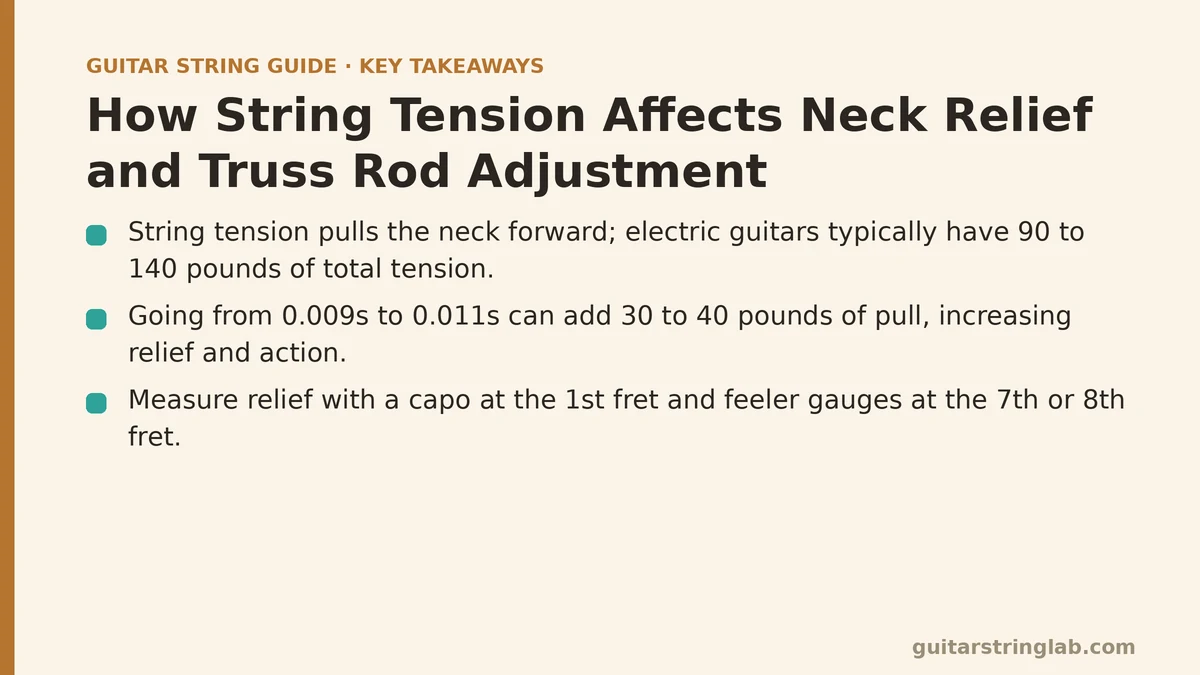
String tension is the force that pulls a guitar neck forward. Every set of strings produces a specific total pull measured in pounds, and most electric guitars land somewhere between 90 and 140 pounds of combined tension depending on gauge and scale length. Going from 0.009s to 0.011s can add 30 to 40 pounds of pull to a neck that was set up for something lighter. That extra force bends the neck forward — more relief, higher action, and buzz in spots that used to play clean.
The truss rod is there to push back against that pull. It’s a steel rod embedded inside the neck that counteracts the strings’ forward bend. But here’s the part that confuses people: not every action problem that shows up after a string gauge change is a truss rod problem. Sometimes the neck is fine and something else moved. What follows walks through the real questions players ask when tension changes, in the order you should check them.
Q: How Much Does String Gauge Really Change Neck Tension?
More than most players expect. Take a standard 25.5-inch scale Strat-style guitar as the reference point.
| String Set | Total Tension (approx.) | Change vs. 0.009s |
|---|---|---|
| 0.009–0.042 (extra light) | ~92 lbs | baseline |
| 0.010–0.046 (regular light) | ~110 lbs | +18 lbs |
| 0.011–0.049 (medium-light) | ~128 lbs | +36 lbs |
| 0.012–0.052 (medium) | ~145 lbs | +53 lbs |
Those numbers shift with scale length as well. A 24.75-inch Gibson-style scale at the same gauge runs roughly 10 to 15 percent lower total tension, since the shorter string span needs less force to reach pitch. A 27-inch baritone or extended-range guitar pushes tension upward by a similar margin.
The practical takeaway: moving up one gauge category is enough to measurably change neck relief. Moving up two often calls for a truss rod turn within a day or two of the string change.
Q: What Does “Too Much Relief” Look Like?
Relief is the slight forward bow in the neck that gives strings room to vibrate without rattling against frets. When heavier strings go on, the increased tension pulls the headstock forward and increases that bow. The symptoms follow a predictable pattern.
First, action at the middle frets feels higher — the 5th through 9th area feels like the strings sit further off the fretboard than before. Second, fretting a note at the 1st fret and another at the 12th fret on the low E reveals a visible gap between the string and the frets around the 7th or 8th fret. Third, bending notes in that middle region feels mushy or indistinct because the string has extra distance to travel before making clean contact with the fret.
To check it yourself: capo the 1st fret, press down on the string at the fret where the neck meets the body (usually the 14th or 15th), and measure the gap between the bottom of the string and the top of the 7th or 8th fret. A business card or a 0.010-inch feeler gauge should slide in with light drag. If you can stack two business cards, or a 0.020-inch feeler gauge slides in freely, relief is too high.
Q: How Do I Know If It’s the Truss Rod or Something Else?
This is the diagnostic step most players skip, and it’s the reason they end up making adjustments that don’t fix the problem. Before touching the truss rod, rule out three other suspects.
Suspect 1: Bridge height. Heavier strings have larger diameter and may catch slightly on saddle grooves or sit higher off the fret tops purely because the saddle didn’t move. Check your action at the 12th fret first. If it’s too high there and there’s too much relief in the middle, you might need both a saddle adjustment and a truss rod turn. If action at the 12th is fine but the middle is high, it’s almost certainly relief.
Suspect 2: Nut slot depth. A heavier string that doesn’t seat fully into its nut slot raises the string’s starting height, which pushes action up across the entire neck, especially in the first five frets. Run a fingernail along the slot — heavier strings often catch or sit proud of the slot edges. That’s a nut file job, not a truss rod job.
Suspect 3: Humidity or temperature shift. Wood moves. A neck that was adjusted in winter at 30 percent humidity can bow forward or back when summer humidity pushes 60 percent, regardless of string tension. If your string gauge didn’t change but relief did, blame the weather before the hardware.
Only after those three check out clean — saddle height confirmed, nut slots seating the new strings fully, and a stable environment — should you turn the truss rod.
Q: Which Direction Do I Turn It, and How Much?
The truss rod works like a bow and arrow reversed. Tightening it (clockwise) straightens the neck by pulling the headstock back. Loosening it (counterclockwise) allows the strings’ tension to bow the neck forward.
For increased relief after going up in gauge, you loosen the rod. But here’s the common error: players hear “loosen” and expect the neck to move right away. It won’t, and turning too far while waiting for a response is how truss rod threads strip.
Use this procedure instead:
- Loosen the truss rod nut by no more than 1/8 to 1/4 turn — counterclockwise.
- Wait 15 to 30 minutes. Wood needs time to relax; the rod’s effect isn’t instant.
- Re-check relief with the capo and feeler gauge method above.
- Repeat in 1/8-turn increments. Most gauge changes need only one 1/8-turn adjustment. Two full turns without measurable change means you’re solving the wrong problem or the neck has an issue that requires a professional.
If you’re going down in gauge, say from 0.011s to 0.009s, the neck loses tension and can back-bow — the middle of the neck rises toward the strings, causing buzz from the 3rd to 5th frets. In that case, tighten the rod clockwise by the same 1/8-turn increments, waiting between each.
Q: When Should the Guitar Be in Tuning During Adjustment?
At full string tension. Some old advice suggests loosening strings before turning the rod to “protect” the neck. In practice, adjusting with the guitar at pitch gives you the correct result because the rod is working against the actual force it needs to counteract.
If you loosen strings completely, turn the rod, and re-tune, you end up with an overshot adjustment — the neck might go from too much relief to too little in one jump. Keep the guitar tuned, make your 1/8-turn, and re-check. For electric guitars, standard tuning at pitch is right. For acoustics, do the same. The rod is designed for this load.
One exception: if the rod feels frozen or you meet strong resistance in the first 1/8-turn, stop and get professional help. A seized truss rod that gets forced will snap or strip, turning a $50 setup into a $300 neck replacement.
Q: Is It Ever Better to Adjust Relief a Different Way?
Sometimes. For small changes — moving from 0.010 to 0.0105 or a factory set that’s borderline — you can compensate with bridge height alone. Raising the saddles adds a small amount of action all along the neck, which masks the buzz or mushiness without changing the neck’s bow. This keeps your truss rod position stable and avoids introducing new variables.
But for the large tension jumps shown in the table above, bridge-only compensation runs out of range. The middle frets will still be too high or too low no matter where the saddles sit. Relief and action are two separate adjustments: the truss rod controls the arc of the entire neck, while the bridge controls string height at specific points. Respect the difference.
Q: What If the Neck Looks Flat When I Don’t Want Flat?
Heavier strings paired with too tight a truss rod — or a rod that was tightened without being loosened after a gauge drop — creates a back-bow. The neck curves upward in the middle. Symptoms: buzz at the 1st through 5th frets, strings that feel stiff and dead, and bending that produces a choking sound because the string runs into the fret crown early.
Check by pressing the low E at the 1st fret and the 14th fret, then measuring the gap at the 6th or 7th fret. If there’s no gap at all — the string touches the frets — the neck is flat or back-bowed. Loosen the rod in 1/8 turns, waiting 15 to 30 minutes between turns, until a 0.008 or 0.010 feeler gauge slides through with light drag.
Q: Do Different Guitar Types Need Different Relief Targets?
Yes, but within a narrow range. Here’s a practical baseline:
| Guitar Type | Target Relief at 7th–8th Fret |
|---|---|
| Electric, standard 25.5" scale | 0.008" – 0.012" |
| Electric, 24.75" scale | 0.010" – 0.014" |
| Acoustic, steel string | 0.010" – 0.016" |
| Bass | 0.014" – 0.020" |
Heavier string gauges on the same guitar can tolerate slightly higher relief — up to 0.014 on an electric — because the thicker strings need more clearance to avoid fret buzz. Lighter strings can run tighter without issue.
Q: What’s the First Sign I Should Never Ignore?
Fret buzz that appears in the middle frets after a string gauge change, even when the action at the 12th fret looks normal. That’s the classic signature of tension-induced relief change. Catch it early — within the first few days of the string swap — and a single 1/8-turn truss rod adjustment usually brings everything back to spec.
Wait six weeks and the neck will have slowly settled into its new bow. The adjustment might take two turns, and you’ll have been playing on compromised action the whole time. The cost of checking early is ten minutes and a feeler gauge.
Q: What Gear Do I Need for This?
No specialized tools beyond what most players own or can buy cheaply.
- A capo (any kind)
- A set of feeler gauges (0.008" through 0.020" covers everything) — about $8 online
- A truss rod wrench that matches your guitar’s nut size (most electrics take 4mm or 5/32", acoustics vary) — usually $5 to $12
- A Phillips screwdriver if you need to adjust saddle height as a follow-up
Skip the expensive action gauges and proprietary rulers. Feeler gauges are accurate to 0.001 inch and cost less than a set of strings.
Q: Does Every String Gauge Change Require a Truss Rod Turn?
Not always. The deciding factor is whether you changed the total tension enough to move the neck. Here’s a quick decision branch:
- Same brand, same material, one gauge step down (0.010 → 0.009): Usually no turn needed. The tension drop is around 18 pounds, which many necks absorb without measurable movement. Check and adjust only if buzz appears.
- One gauge step up (0.009 → 0.010): Check relief. Some guitars need a small loosening; many don’t. Verify before turning.
- Two gauge steps up (0.009 → 0.011) or moving from light to medium: Plan on loosening the truss rod 1/8 to 1/4 turn, and budget a day for the neck to settle.
- Changing string material (pure nickel to stainless, or nickel-plated steel): Tension differences between materials at the same gauge are under 5 percent — normally no truss rod change required. The tone and feel change, but the neck doesn’t care.
Q: How Long Should I Play Before Judging the Result?
Give it two to three days of regular playing after the adjustment. Fresh strings need time to stretch and settle, and the neck wood needs time to fully respond to the new tension balance. Playing for an hour, feeling relief, and immediately cranking the rod further is how you overshoot.
Instead, adjust once, play for two days, then re-check. If it’s still high, do another 1/8-turn and repeat the wait. The process is slow because that’s how wood works — forcing it faster is how threads strip and rods snap.
Your Next Step Today
Here’s the sequence to run right now, before you touch anything:
- Write down your current string gauge and brand. If you don’t know, that’s step 0 — check the string package or measure the diameter of the high E string with a caliper or feeler gauge.
- Capo at the 1st fret, press at the 14th, measure the gap at the 7th. Compare it to the target table above for your guitar type.
- If relief is out of range and you’ve recently changed gauge, do one 1/8-turn of the truss rod in the correct direction. Wait 30 minutes, re-measure.
- If relief is out of range but you haven’t changed strings recently, check bridge height and nut slots first. A truss rod turn won’t fix a saddle that’s too high or a nut slot that’s too shallow.
Do that today and you’ll have concrete numbers to compare against after tomorrow’s practice session. If you want help interpreting what your specific measurement means for your guitar model, provide your guitar type, current strings, and the gap you measured at the 7th fret — this information helps determine whether to turn the rod, adjust the bridge, or leave it alone.
Related guides: Beginner’s Guide to Adjusting Truss Rod Neck Relief, How to Measure Guitar String Action, and Guitar String Gauge Guide.