After reading this guide, you’ll be able to pick between nylon and fluorocarbon strings with a clear reason behind your choice — one that accounts for your guitar’s body, your right-hand technique, and the tone you’re after. You’ll also see why “just try both” isn’t wrong so much as it is an easy way to burn money on sets you didn’t need. Here are the questions that actually drive this decision.
What’s the Real Difference Between These Two Materials?
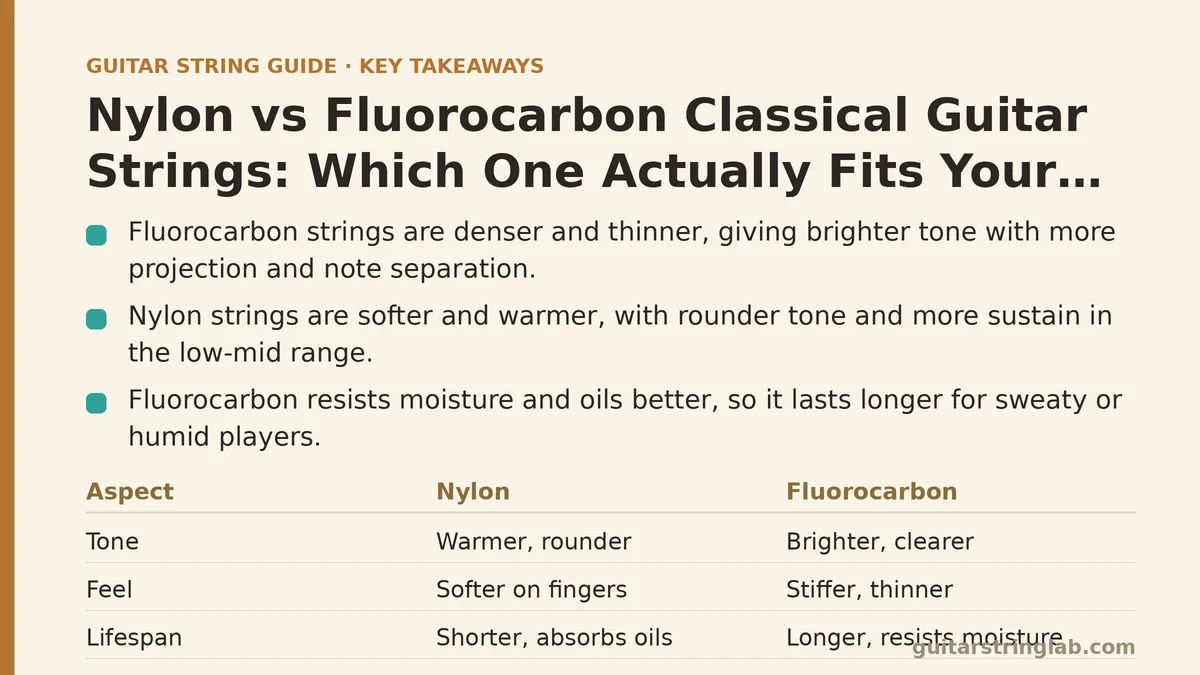
Nylon is a softer, lighter polymer, and it’s held the standard spot for treble strings since it took over from gut in the mid-20th century. Fluorocarbon is denser and stiffer at a given diameter, so a fluorocarbon string has to be thinner than a nylon string of equivalent pitch and tension.
That density gap sits underneath just about every other difference between the two. Fluorocarbon passes vibration along more efficiently and loses less of it to internal damping, which is what you hear as brightness and articulation. Nylon soaks up more of that energy inside the material itself, softening the attack and taming the top end. Neither one is a defect — they’re separate physical responses to the same string tension.
Which One Sounds Better?
In the abstract, neither. This comes up more than any other question, and it has the least useful single answer, because “better” only means something once you factor in your guitar and your ears.
Fluorocarbon reliably gives you more projection, cleaner note separation, and a brighter overall voice. Put it on a guitar that’s already warm or slightly muffled — plenty of cedar tops, or older instruments with a mellow build — and it can bring back clarity you hadn’t noticed was gone. Put it on a guitar that’s already bright, especially many spruce tops, and it can tilt the sound toward thin and harsh.
Nylon gives you a rounder, warmer voice, less separation between notes, but more perceived sustain through the low-mid range. On a bright guitar, nylon tends to sit more balanced and wears less on your ears across a long practice session. On a warm guitar, nylon can come across closed-in or muddy, particularly on the wound basses that come with a nylon treble set.
Not sure which camp your guitar belongs to? Play an open G chord and pay attention to whether the treble strings ring out distinctly against the basses or whether the whole thing blurs into one wash of sound. If it blurs, fluorocarbon’s extra clarity is probably worth trying.
Does Fluorocarbon Really Last Longer?
Yes — this is one of the more consistently reported advantages, and it shows up across players and manufacturers alike. Fluorocarbon holds off moisture and finger oils more effectively than nylon, mostly thanks to its denser molecular structure and lower porosity. Practically speaking, that means slower tonal decline over weeks of regular playing, and less of the dull, dead feel nylon trebles pick up as oils work their way into the material.
For players who sweat a lot, live somewhere humid, or gig often enough that strings never get a rest between sessions, this counts for a lot. For someone practicing half an hour a day in a climate-controlled room, it counts for less — nylon’s shorter lifespan rarely becomes the thing limiting your tone.
Which One Is Easier on the Fingers?
Nylon wins this one in nearly every case worth discussing. The softer surface and extra give under fingertip pressure make it clearly kinder for beginners, for anyone nursing sore fingers, and for long stretches of slow-tempo repertoire where your fingers stay in contact with the strings.
Fluorocarbon’s density shows up as a firmer, occasionally glassy feel under the fingertip. Plenty of experienced players like that, since it delivers clearer tactile feedback on fast passages. Beginners often find it uncomfortable, particularly in those first weeks before calluses form. If classical guitar is new to you, starting on nylon and moving to fluorocarbon after your technique and calluses have settled in is a sensible, low-risk path.
Do These Strings Behave Differently Under Tension?
They do, and plenty of players get caught out switching between them without recalibrating their expectations. Since fluorocarbon hits the same pitch at a thinner gauge, a “normal tension” fluorocarbon set can feel tighter or stiffer under the fingers than a “normal tension” nylon set, even when both carry the same nominal rating.
This isn’t true of every brand — tension ratings differ by manufacturer and aren’t fully standardized — but it’s common enough that swapping materials without checking tension specs can leave you with action that’s harder than you expected, which shows up most in bends, slides, and the vibrato technique classical repertoire leans on. If your guitar’s setup was built around one material, plan for a short adjustment period when you switch, and possibly a saddle height check.
Are the Bass Strings Different Too, or Just the Trebles?
The nylon-versus-fluorocarbon question only concerns the treble strings — the wound basses (typically silver-plated copper wrapped around a core) stay broadly the same no matter which treble material you pair them with. That said, the core under the winding does change from set to set, and some manufacturers build fluorocarbon-core basses specifically to complement brighter trebles.
Pair a bright fluorocarbon treble set with a duller, older-style nylon-core bass set and you can get a noticeable tonal seam between the D and G strings, where the character shifts abruptly. If you’re going fluorocarbon on top and want one cohesive voice across all six strings, check whether the set ships with a matched bass or whether you’ll need to buy one on its own.
Which Should Beginners Buy First?
Nylon — for two practical reasons that have nothing to do with tone. It’s gentler on fingertips that haven’t toughened up yet, and it forgives imprecise technique, softening some of the harsh, uneven sound that comes from inconsistent nail or fingertip contact early on. Fluorocarbon exposes technique flaws more plainly, which is useful once you’re deliberately refining tone but aggravating while you’re still figuring out where your fingers go.
After you’ve built calluses and settled into consistent right-hand contact — usually a few months of regular practice — a fluorocarbon set becomes a reasonable experiment instead of a discouraging one.
Can You Mix Materials on the Same Guitar?
Some players do this on purpose: fluorocarbon trebles with a nylon-core bass set, or the other way around, hunting for a tonal middle ground neither pure set delivers. It’s a legitimate route, and several manufacturers sell mixed sets built for exactly this rather than leaving you to guess.
If you mix your own, expect some trial and error. A bright treble voice against a warmer bass voice — or the reverse — won’t always land where you’d guess, and the only dependable way to judge it is to string up the combination and play it for a few days past the initial break-in.
How Do I Actually Decide, Right Now?
Begin with what you already know about your guitar’s natural voice. Bright and clear already: lean nylon. Warm or slightly closed-in: lean fluorocarbon. Beginner: nylon no matter what your guitar sounds like, for your fingers’ sake. Gigging or performing regularly and needing consistent tone across a run of shows without restringing: fluorocarbon’s durability edge starts to matter more than you’d think.
| Priority | Better Fit |
|---|---|
| Guitar already sounds bright | Nylon |
| Guitar sounds warm or muffled | Fluorocarbon |
| Beginner, still building calluses | Nylon |
| Frequent performer, needs longevity | Fluorocarbon |
| Want maximum note separation | Fluorocarbon |
| Want warmth and finger comfort | Nylon |
None of this stands in for stringing up a set and listening on your own instrument — guitars are individual enough that a particular top, bracing pattern, or player’s touch can override the general tendencies. Use the table to narrow the field, then let your ears close the deal.
Does your guitar lean bright or warm right now, and which side of that table lines up with what you’re hearing? Tell the tonewood and it becomes possible to narrow down a starting set.
Related guides: How to String a Classical Guitar, Guitar String Materials Explained, and Best Acoustic Guitar Strings for Beginners.