Say you are loading your gig bag the night before a two-week run. You grab the same 0.010 set you have been playing at home for months, the one that feels perfect under your fingers in your bedroom. By the third show, that set is fighting you. Meanwhile, a 0.011 set that felt like wrestling a fence post at home might sail through an entire festival circuit without a single tuning complaint. The string isn’t the variable here — it’s everything the road throws at it that you don’t notice until you’re under stage lights.
Touring wrecks every condition that string performance depends on: humidity that swings from venue to venue, a van that bakes in the sun and freezes overnight, sweat that stays on the strings until after the encore, and the low-grade panic of knowing a snapped string means a rushed swap during a 60-second gap between songs. What follows is organized around the decisions you’ll actually face at each stage of a tour.
| Decision | Options | Best For | Watch-Out |
|---|---|---|---|
| High E gauge | 0.009–0.010 | Sets under 45 min | Wear at 6–10 hrs |
| High E gauge | 0.011 | Longer tours, short sets | Finger fatigue |
| Set length | Over 45 min nightly | Stay within one gauge of home | Tired hand, mistakes |
| Set length | Shorter sets | Step up one full gauge | Switch back at home |
| Fast changes | 0.010–0.011 | Grip and first-try seating | More bend effort |
| Wrap count | 2–3 wraps | Quick swaps | — |
| Wrap count | 5–6 wraps | — | Slower changes |
| Coating | Coated | Damp vans, sweaty rooms | Ball end can catch |
| Coating | Uncoated | — | Oxidizes in 24 hrs |
| Tools | Two pairs of wire cutters | Mid-song swaps | — |
Q: Do Heavier Strings Really Last Longer on the Road?
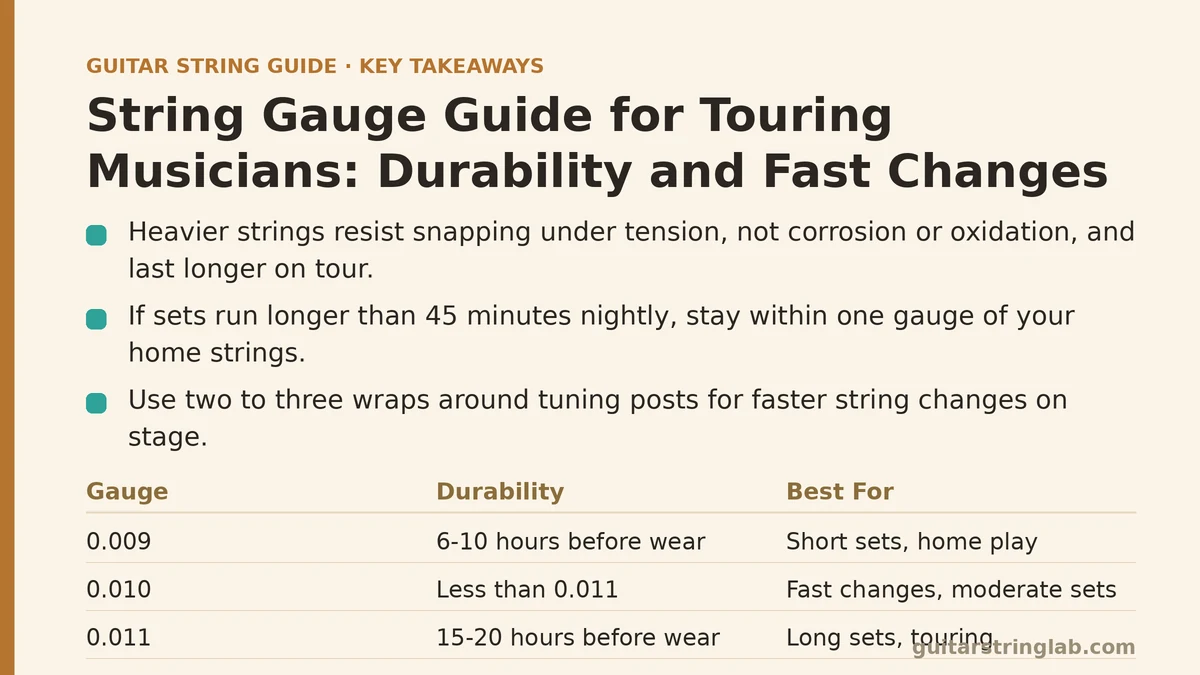
They do, but the reason isn’t the one most players cite. A heavier string doesn’t fight corrosion any better, and it doesn’t resist oxidation any better. What it resists is snapping under tension. Thinner strings carry the same load with less metal, so fatigue cracks form sooner at the bend points around the bridge saddle and tuning post.
Among touring players, a 0.009 or 0.010 high E string commonly shows visible wear at the contact points after 6–10 hours of aggressive playing. A 0.011 high E under the same conditions often goes 15–20 hours before reaching that same level of stress. That gap adds up: across a 12-show tour, it can be the difference between packing one spare set and packing three.
The cost is finger fatigue. Heavier strings ask more of your hand, and a tired hand makes more mistakes. Playing 60–90 minutes every night compounds that physical toll. Playing 30-minute opening sets? Heavier strings become the safer call.
Practical guideline: If your set runs longer than 45 minutes nightly, stay within one gauge of what you play at home. If your sets are shorter, step up one full gauge for the tour and switch back once you’re home.
What Gauge Works Best for Fast String Changes?
This is a logistics question more than a tone question. The fastest change has less to do with gauge thickness than with how many wraps sit around the tuning post and how cleanly the ball end seats in the bridge.
For speed, you want the thickest string that still plays comfortably, because thicker strings are easier to grip during the swap. A floppy 0.009 set that keeps sliding out of your fingers mid-change costs you more time than a 0.011 set that takes a little more effort to bend but seats on the first try.
The real time-killer is wrap count. Most players wind five or six wraps around the post, which is overkill. Two to three wraps lock securely and come off faster when a string breaks. If you’re swapping between songs, the gap between a three-wrap and a six-wrap post is the gap between a 90-second change and a 2-minute change. Over a 20-song set, that’s a real dent in stage momentum.
If you want the fastest possible change: Use a 0.010 or 0.011 gauge, pre-cut your string ends to length before the show, and keep two pairs of wire cutters on your pedalboard — one for the old string, one for the new. No fumbling for a tool mid-song.
Q: Does Coating Matter More or Less on the Road?
Coating matters more on the road, but not for tone reasons. The polymer layer on coated strings blocks moisture from reaching the steel core. That becomes relevant when your guitar sits in a damp van overnight or in a sweaty dressing room for three hours before downbeat. Uncoated strings will begin oxidizing from ambient humidity within 24 hours of exposure. Coated strings can hold that off for a week or more.
The catch: coating also changes how the string behaves during a fast change. The coating on the ball end can make it harder to seat in some bridge designs, especially tremolo-equipped guitars with flush-mount bridges. If you’re routing strings through the back of the guitar, the coated ball end can catch on the block.
If you tour with a tremolo: Test a coated set at home before committing. If the ball end won’t seat cleanly, stick with uncoated and carry twice as many spares.
If you tour with a fixed bridge: Coated strings are the stronger choice. A single coated set can last the entire tour if you wipe the strings after each show.
Q: How Should I Adjust Gauge When Jumping Between Alternate Tunings?
If your setlist includes dropped D, open G, or a half-step-down tuning, the gauge math changes. Lower tunings put less tension on the string, which means you can step up a gauge without making the strings feel stiffer under your fingers. That works in your favor: a 0.011 set tuned down a half step will feel roughly like a 0.010 set at standard tuning.
The danger is on the return trip. Tuning up to a higher tuning from a lower one mid-set can push tension past what a string can tolerate. A 0.011 set tuned up to standard from a drop-tuning position is fine. A 0.011 set tuned up a full step beyond standard — say, from dropped D to E standard — will be under more tension than the string was designed for, and the likelihood of snapping increases sharply.
Decision rule: If your alternate tuning is lower than standard, keep your usual gauge or step up one gauge. If your alternate tuning is higher than standard, step down one gauge or avoid the higher tuning entirely on tour.
Q: What’s the Best Spare-String Strategy for a Multi-City Run?
Carrying spares is about more than having a backup set. You need a system for knowing what’s in your bag, what condition it’s in, and what you’ll run out of after which show.
Here’s the approach worth adopting for touring players:
- Carry three full sets per week of touring. That covers one broken string per show on average, plus one full restring mid-week if your tone starts degrading.
- Pre-cut your high strings (E, B, G) to length at home. These break most often. Cut them two days before departure and tape them together in order.
- Keep a dedicated “emergency” set that never touches the guitar. Tuck it in a separate pocket of your gig bag. This is your insurance policy for a broken string on stage with no time to think.
- At the start of each week, check the high E and B strings from the previous batch. If they show kinks or discoloration near the bridge contact point, they’re already compromised. Replace them before they break.
This system costs about 20 minutes of prep time and saves you from the single worst touring scenario: a broken string with no backup 400 miles from the nearest guitar shop.
Q: What Gauge Is the Best Overall Compromise for a Working Touring Musician?
If one set had to be handed to a player doing 5 nights a week, 6 weeks straight, with no backup instrument, it would be a 0.011 to 0.049 nickel-plated steel set, uncoated, with a pre-cut high E and B. That’s not the brightest or the warmest or the easiest-playing set on the shelf. It’s the set that balances all three priorities: enough metal to survive road wear, enough brightness to cut through a mix without extra EQ, and a wrap material that ages predictably rather than going dull overnight.
The 0.011–0.049 gauge gives you the durability of a heavier set while staying within reach of most players who practice regularly. Nickel-plated steel holds its tone longer than pure nickel under sweaty conditions, but doesn’t get as brittle as stainless steel. Uncoated keeps the response immediate — no coating to dampen the signal — and the faster degradation is a fair trade when you’re changing strings weekly anyway.
If you prefer lighter: Drop to 0.010–0.046 and carry one extra set per week. If you prefer heavier: Step up to 0.011–0.052 and expect to adjust your truss rod after the first day.
Q: How Do I Recover When a String Breaks Mid-Set?
The string breaks, the song doesn’t stop, and you have less than a minute to fix it. Here’s the sequence that works:
- Kill the volume on that string’s pickups immediately. A broken string flapping against the fretboard creates noise that cuts through the mix.
- Pull the broken string out of the bridge and tuning post in one motion. Don’t unwind it — just pull it through.
- Thread the new string through the bridge first, then the tuning post. Bridge-first is faster because the ball end seats itself under tension.
- Wrap twice around the post, tune up, and check intonation with one quick bend. Don’t aim for perfect pitch — aim for close enough to finish the song, then fine-tune during the next instrumental break.
Practice this four-step sequence at home until it takes under 90 seconds. The players who look calm mid-crisis are the ones who rehearsed the emergency.
Q: What’s the Best Way to Test a Gauge Before Committing to It for a Tour?
A three-night mini-tour is the minimum test window. One show tells you whether the gauge feels okay. Three shows tell you whether it holds up under repeated travel, varying climates, and the accumulated sweat of consecutive performances.
During that test run, track two numbers: how many times you re-tune between songs, and whether any high strings develop kinks or flat spots by the end of the run. If you’re re-tuning more than once per song, the gauge is too light for the tension you’re playing at. If kinks appear within two days, the strings aren’t handling your bend pressure — step up one gauge and try again.
Pre-Tour String Load-Out Checklist
Use this the night before load-in so gauge, spares, and coating choices match the actual run—not your home practice room.
| Item | What to do |
|---|---|
| Gauge vs set length | Sets over 45 minutes nightly: stay within one gauge of home. Shorter sets: step up one full gauge for the tour, switch back at home. |
| Spares | Pack about three full sets per week of shows (one break per night on average, plus a mid-week full change if tone fades). |
| High strings | Pre-cut E, B, and G at home; tape in order two days before departure. |
| Emergency set | One untouched set in a separate gig-bag pocket—only for on-stage crises. |
| Weekly audit | Before each week, replace high E/B that show kinks or discoloration at the bridge contact point. |
| Fast changes | Favor 0.010–0.011, two to three post wraps, bridge-first threading; rehearse under 90 seconds. |
| Coating | Fixed bridge: coated often wins on the road. Tremolo: test coated ball-end seating at home first. |
| Alt tunings | Lower than standard: same gauge or +1. Higher than standard: −1 gauge or avoid that tuning on tour. |
| Tools | Two wire cutters on the board (old string / new string) if you swap mid-set. |
If a three-night run still needs constant re-tuning or kinks appear by night two, the gauge is too light for your bend pressure—step up one and retest before the long leg.
Planning a tour? Match your setlist length, consecutive show nights, and current gauge against the durability and change-speed tradeoffs in the sections above to decide whether to keep your present set or step up for the road.
Related guides: Guitar String Gauge Guide, Coated vs Uncoated Guitar Strings, How Long Do Guitar Strings Last, and How to Change Electric Guitar Strings.