Most guitar players replace strings because of rust. Most of those strings did not rust for the reason the player assumes. A string that corrodes in three days and a string that corrodes in three months are failing from completely different attacks, and treating both with the same wipe-down routine means neither problem gets solved.
This guide breaks string corrosion down into the four specific causes you will run into, matches each one to the warning signs it leaves behind, and gives you a fix you can apply today. No vague advice about wiping down your strings — you already know that part. The question is which of these four enemies you are dealing with, because the answer changes what you do next.
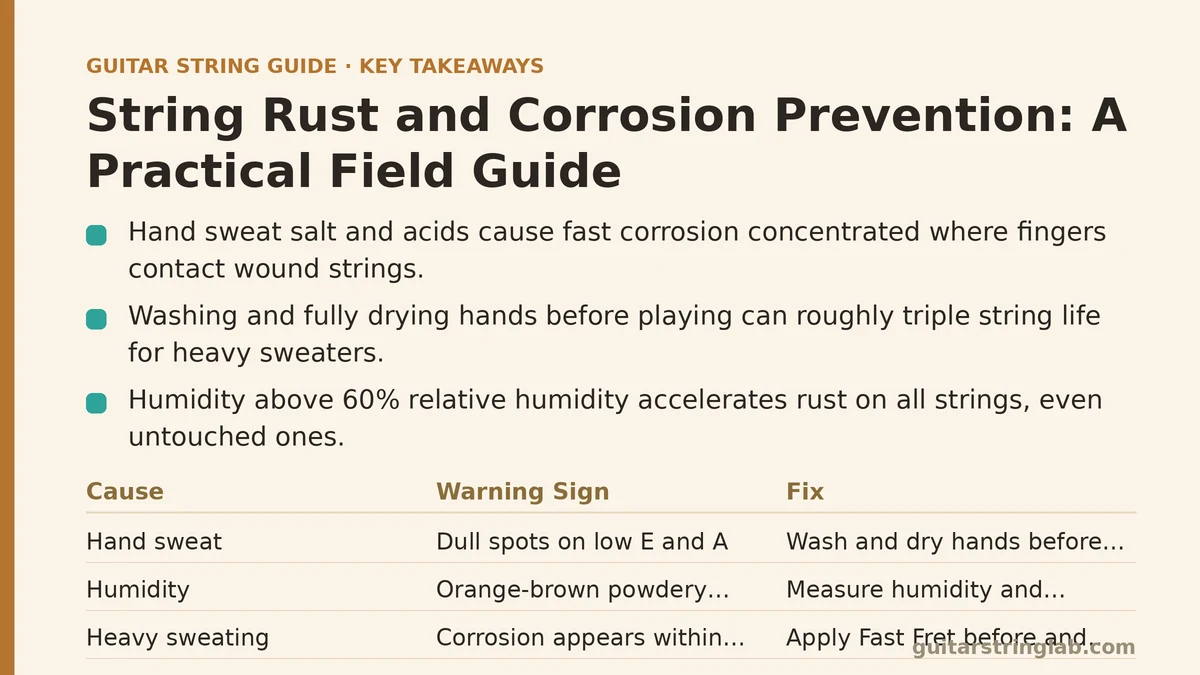
Cause #1: Hand Sweat and Skin Oils (The Fastest Killer)
Symptom: Dull spots appear first on the low E and A strings, right where your fingers land most often. Within a few days, the windings look dirty even after wiping. The guitar smells faintly metallic when you open the case.
What is happening: Your sweat contains salt, chloride ions, and acids that attack the metal coating on the wound strings. The reaction is electrochemical — the salt creates a tiny battery between the wrap wire and the core wire underneath. This is why the problem concentrates exactly where your hand rests, not evenly across the whole set.
The fix in practice: Wash your hands before every session, not just when they look dirty. Oils transfer even when your skin feels dry. Dry your hands completely — moisture dilutes the protective coating on the strings and makes the salt more aggressive.
For players with heavy sweating, the gap between plain wiping and hand washing works out to roughly triple the string life. Identical sets, same guitar, same room — one player gets three weeks and another gets nine. The only variable is hand chemistry and whether they wash before playing.
If you sweat heavily: Use Fast Fret or GHS Fast Fret-type products before playing, not just after. A light layer applied before your hands touch the strings acts as a barrier. Apply again after playing, then wipe dry with a cotton cloth. This routine tends to double string life for players who follow it, even in summer months.
Cause #2: Humidity in the Storage Environment
Symptom: Rust appears in patches across all strings equally, even the unwound high E and B strings that never touch your fingers. The corrosion looks orange-brown and powdery, not just dull. It shows up on guitars stored in cases for weeks without being played.
What is happening: Airborne moisture condenses onto metal surfaces and starts oxidation. The reaction accelerates above roughly 60% relative humidity — the typical indoor level in summer without air conditioning, or in basements, or near windows where temperature changes create condensation cycles.
Consider the contrast: a set of uncoated strings left in a 70% humidity room for 30 days usually shows visible rust formation on the unwound strings by day 18. The same set in a 45% humidity room commonly shows almost no corrosion after 45 days. Humidity is not a slow background factor — it is the deciding factor when your guitar sits idle.
The fix in practice: Measure, do not guess. A digital hygrometer costs $10 and removes the mystery. If the room where you store the guitar reads above 60%, you have two options — dehumidify the room or seal the case better.
For room-level control, a small electric dehumidifier rated for a bedroom keeps a room in the 40–50% range. For case-level control, silica gel packs rated for guitar cases absorb moisture inside the sealed compartment. Check them monthly — they saturate and stop working without a visual cue.
If you store your guitar in a case: Keep the case closed when you are not playing. An open case exposes strings to whatever the room is doing, which defeats the purpose of storing the guitar in a protected space. Also remove the guitar after long-term storage and let the room air reach it — cases can trap pockets of humidity even when the room is dry.
Cause #3: Micro-Abrasions From Heavy Fretwork and Fretting Technique
Symptom: Flat spots appear on the underside of the wound strings, directly above each fret. The tone goes dead in specific notes — usually around frets 3 through 7, where you do most of your bending — while the rest of the string still sounds fresh. The surface looks polished, not rusty, almost like the metal has been sanded there.
What is happening: Pressing the string into the fret creates friction, and hard bending creates a sawing action between the string and the fret wire. This removes the protective outer layer of the wrap wire in tiny strips. Once that layer is gone, the exposed inner metal corrodes much faster because it has no coating protection.
This is the most common cause of “my strings sound dead but they do not look rusty” — the metal is not rusting, it is wearing thin in specific zones.
The fix in practice: Smooth, polished frets make the biggest measurable difference. If you can see surface rust on the fret wire itself, that roughness is chewing through your strings. A quick fret polish with 0000 steel wool or a microfiber cloth with metal polish removes the microscopic burrs that accelerate string wear. This one maintenance step typically extends string life by 30–40% for heavy benders.
For your technique, check your grip pressure. Many players press harder than necessary, especially during bends. The difference between a tight death grip and a controlled press is noticeable in string wear patterns within a single session. Play with the lightest pressure that still produces clean notes — your strings will show the difference within a fortnight.
Cause #4: Environmental Pollutants and Airborne Chemicals
Symptom: Corrosion appears in a scattered pattern, not concentrated where your hand lands and not uniform like humidity damage. Tiny dark spots form randomly across all strings, including the unwound ones, sometimes within a couple of days. The spots look like dark freckles rather than an even dull haze.
What is happening: Kitchen smoke, cleaning products, air fresheners, paint fumes, and even the sulfur compounds from burning candles all react with string metal. These airborne chemicals dissolve into the thin layer of condensation on the strings and attack the surface. This is among the most underdiagnosed causes because players assume a closed case protects the strings — it does not, unless the case itself is sealed.
The fix in practice: Keep your guitar out of the kitchen and away from rooms where you clean with spray products or burn candles. Cigarette smoke is especially aggressive — strings can corrode within 48 hours in a heavily smoked room, regardless of whether the guitar was played.
If your practice space doubles as a dining area or a room where you use cleaning products, store the guitar in a different room entirely. A dedicated guitar gig bag with a sealed zipper and a desiccant pack inside provides more protection than an open room with all the windows closed.
Quick-Reference Diagnosis Table
| What you see | Likely cause | First action |
|---|---|---|
| Dull spots on low E/A, concentrated where your hand lands | Hand sweat and oils | Wash hands before playing, use a barrier product |
| Orange-brown rust on all strings, not played for days | Humidity above 60% | Measure room humidity, add silica gel to case |
| Flat polished spots above frets, rest of string fine | Fretting friction | Polish frets, reduce grip pressure |
| Scattered dark freckles, short timeline | Airborne pollutants | Move guitar to a different room, stop burning candles nearby |
The Routine That Covers All Four
You do not need a complicated ritual. You need four specific actions done consistently, in this order:
Before playing: Wash and dry hands. Apply a thin barrier layer of string lubricant if you sweat heavily.
After playing: Wipe each string individually with a dry cotton cloth — not a paper towel, which leaves lint and is usually rough enough to micro-scratch. Run the cloth along the full length of each string, from bridge to nut, on both the top and bottom surfaces.
Weekly: Visually inspect all six strings under good light. Look for the patterns in the table above. Catching corrosion at day three versus day ten makes a substantial difference in whether it spreads to the core wire.
Monthly: Check your storage environment. Read the hygrometer. Replace silica gel if it has been more than six weeks. Polish frets if you notice flat spots forming on strings.
The players who get maximum life from their strings — consistently two to three times the average — are not using exotic products. They are doing these four steps on schedule, and they are catching the specific cause that applies to their situation rather than applying a generic “wipe the strings” approach that addresses only one of the four problems above.
Which of the four symptoms have you seen most on your strings — the dull spots from your hand, the orange rust from humidity, the flat spots from fretting, or the scattered freckles from the air? Describe the pattern and I will tell you which routine adjustment matters most for your setup.
Related guides: How Humidity Affects Guitar Strings, Coated vs Uncoated Guitar Strings, and How to Clean Guitar Strings to Make Them Last Longer.