By the end of this post, you’ll know what a tapered core string is, what it changes at the bridge and the tuning post, when it’s worth paying extra for, and how to test one fairly against your current set.
If you’ve been chasing a slightly dead low E right at the saddle, or wondering why some players swear their tuning stability improved after a string brand switch at the same gauge, the term “tapered core” probably crossed your path at some point. It usually gets mentioned in passing, as though the meaning were obvious. It isn’t, and the practical difference is more concrete than the marketing language around it suggests.
This isn’t a cosmetic feature. Tapered construction alters how a string behaves at two specific points — the bridge and the tuning post — while the vibrating length between them stays exactly the same. That’s a narrow, deliberate change. Knowing precisely what it does tells you whether to seek it out or ignore it.
Step 1: Understand What “Tapered” Actually Refers To
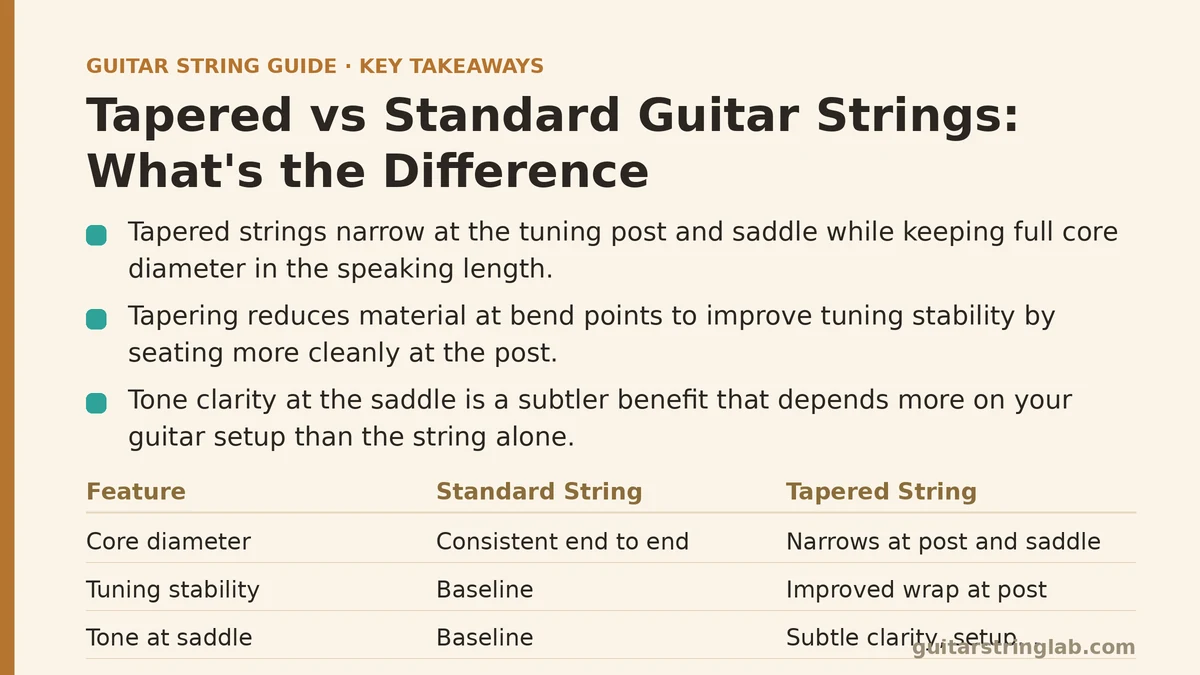
Take a standard guitar string, wound or plain. Its core diameter stays consistent from the ball end all the way to the tuning post. A tapered string is different: it narrows at both ends, thinning slightly where it wraps around the post and where it crosses the saddle, while the core through the speaking length keeps its full diameter.
The taper is subtle, often only a few thousandths of an inch, but it lands precisely at the two contact points where the string bends sharply around metal. That placement is intentional, not a byproduct of manufacturing. It’s a targeted response to where strings take the most mechanical stress.
Step 2: Know Why Manufacturers Bother With This at All
Any time a string bends around a tuning post or a saddle, stress concentrates at that bend. Over time, that concentration feeds two separate problems: tuning instability, as the string settles and stretches unevenly at the post, and a slight dulling of tone right where the string breaks over the saddle.
Tapering removes material at exactly those two locations. The string seats more cleanly around the post and makes better contact against the saddle. With less bulk bunching up at the wrap point, there are fewer microscopic gaps for the string to settle into as you tune up — which in practice means fewer trips back to the tuner during the first few songs of a session.
Step 3: Separate the Tuning Stability Claim From the Tone Claim
These are two distinct benefits, and treating “tapered strings are better” as one blanket statement muddies the picture.
Tuning stability is the improvement players report most consistently. A tapered string wraps tighter and more evenly around the tuning post, because there’s less bulk at the wrap point fighting against a clean coil. If you retune often — drop tunings, heavy tremolo use, aggressive bending — this is the part you’ll notice first and most clearly.
Tone at the saddle is a subtler claim, and how much it shows up depends more on your setup than on the string by itself. A thinner core over the saddle theoretically transmits vibration with slightly less mass damping the contact point, which some players describe as extra clarity or sustain at the bridge end. Across a range of guitars, this effect tends to appear more reliably on acoustics with defined saddle contact than on electrics with adjustable saddles, where other setup variables mask it.
Step 4: Check Whether Your Guitar Can Actually Use the Benefit
Tapering matters only if your hardware interacts meaningfully with the tapered sections. On an acoustic with a fixed bone or synthetic saddle and a standard pin-and-slot bridge, the saddle break angle is consistent, giving the taper a clear, stable surface to sit against.
Electrics depend heavily on bridge type. A hardtail with fixed saddles behaves much like an acoustic in this respect. A floating tremolo introduces more variables — saddle angle shifts with arm use, and the benefit of a tapered break point gets diluted by everything else in motion. Tapered strings aren’t useless on a tremolo-equipped guitar, but the tuning stability gain is likely to matter more than any saddle-tone difference.
Step 5: Weigh the Cost and Availability Tradeoffs
Tapered strings cost more, typically somewhere between 15 and 30 percent above a comparable standard set from the same manufacturer, and a smaller pool of brands makes them. That narrows your options if you’re loyal to a particular wrap material or coating type — your exact combination may not exist in tapered form.
One practical wrinkle is worth knowing before you install a set: tapered strings are more sensitive to winding technique at the tuning post. Because the thinned section is short and specifically placed, sloppy winding that bunches the string at the post can partially cancel out the benefit you paid for. Wind cleanly, keep the coils tight and non-overlapping, and the taper does its job. Rush it, and you’ve spent extra money on a string that behaves like a standard one.
Step 6: Decide Based on Your Actual Playing Situation
Here’s a rough filter for “worth trying” versus “skip it,” based on what tapered construction is built to solve.
| Player Situation | Tapered Strings Worth It? | Why |
|---|---|---|
| Frequent drop tuning or capo changes | Yes | Post-wrap stability reduces retuning time noticeably |
| Heavy tremolo/whammy bar use | Likely, but secondary to other setup factors | Bridge tone benefit diluted by moving saddle |
| Acoustic fingerstyle, fixed saddle | Yes | Clean saddle contact shows the tonal benefit most clearly |
| Casual rhythm player, standard tuning | Optional | Benefit is real but may not be noticeable enough to justify cost |
| Budget-conscious or brand-loyal to a specific coating | Skip for now | Limited availability may not match your preferred spec |
Treat this as a starting filter, not a final verdict — the only way to know for certain is to put a set on your own instrument and compare it directly against what you’re currently using.
Step 7: Run a Fair Comparison If You Decide to Test One
If you’re on the fence, don’t swap in a tapered set and judge it against your memory of the old strings — memory is unreliable for a comparison this subtle. Instead, install a tapered set, play it for a full week under normal conditions, and track two things specifically: how many times you retune during a session, and whether notes near the bridge or saddle feel different under your fingers than what you remember.
Then switch back to a standard set of the same gauge and material for a week and repeat those observations. That deliberate back-to-back comparison, rather than a casual impression, is the only way to know whether the difference matters enough for your playing to justify the extra cost.
Tapered construction solves a narrow, specific problem — stress concentration at two contact points — and it solves it consistently for tuning stability, more variably for tone depending on your bridge type. It’s not a universal upgrade, but it’s not a marketing gimmick with nothing behind it either.
Related guides: Guitar String Materials Explained, Hex Core vs Round Core: Which Is Right For You, and Guitar String Gauge Guide.